
Hello and a very warm welcome back to the blog and podcast! It’s so good to have you here for another episode of ‘The Busy Business Owner’s Guide to Marketing’.
Today, we’re diving into a strategy I absolutely love because it’s one of the most powerful, elegant, and often overlooked shortcuts to meaningful growth. I see so many incredible founders out there grinding day and night to build an audience from scratch. The hustle is real, and I admire it tremendously. But let me ask you a question: What if you didn’t have to start from zero?
Why spend months, or even years, trying to gather a crowd in an empty stadium when you could be invited onto a stage where the seats are already filled with your ideal fans?
That, my friends, is the magic of strategic partnerships. We’re going to explore how you can turn these symbiotic business relationships into one of your core marketing pillars, allowing you to tap into pre-built, engaged communities that are ready to listen. It’s a game-changer, and I can’t wait to break it down for you.
The ‘Why’ Behind the Partnership Play
Before we get into the how, let’s talk about the why. When I look at successful partnerships, I always find it boils down to three huge, undeniable wins.
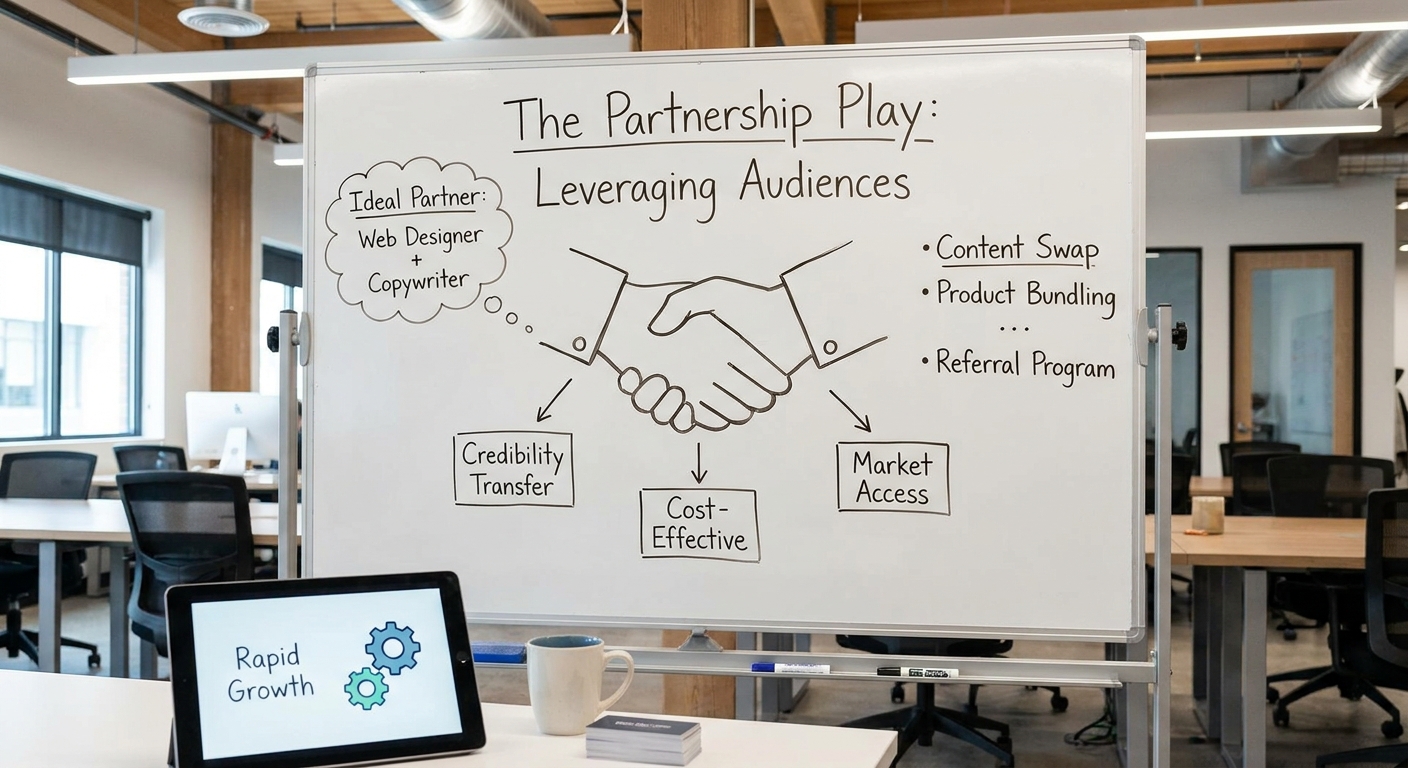
- The Credibility Transfer Let me paint a vivid picture. Imagine you’re at a party, and a close friend you deeply trust walks over and says, “You have to meet Sarah. She’s brilliant at what she does, and I know you’ll love her work.” How do you feel about Sarah in that moment? You’re instantly interested, right? You’re already 80% of the way to trusting her, simply because your friend vouched for her.
That’s credibility transfer in action. When a business your ideal customer already follows, trusts, and buys from recommends you, their audience is immediately pre-warmed. It’s like getting a glowing reference from a trusted source. This is powerful social proof that works for you before you’ve even said a single word.
- It’s Incredibly Cost-Effective Let’s be honest, marketing can feel like a huge financial gamble, especially when you’re pouring money into paid ad campaigns that may or may not deliver. Partnerships, on the other hand, are often an investment of time and creativity rather than a massive budget. The ‘cost’ might be the time it takes to co-host a webinar or write a guest post. When you compare that to the potential five-figure price tag of a big ad spend, you can see why this is such an attractive route for sustainable growth.
- Instant Market Access This is the big one. A strategic partnership is an instant pathway into a targeted, niche audience you might otherwise struggle to reach. Think of it as a VIP key that unlocks the door to a room filled with your perfect customers. Instead of shouting into the void of the internet, you’re being handed a microphone in a space where everyone is already listening. This can seriously accelerate your growth, shaving months off your timeline.
How to Find Your Perfect Partner
Alright, so this all sounds great in theory, but where do you even begin? How do you sift through the noise to identify that perfect partner who will be a genuine asset to your brand? My process is to work through a simple but powerful checklist.
- Look for a Complementary, Non-Competitive Service. This is the foundation. You’re looking for a business that serves the same customer as you, but in a different way. A classic example is a brilliant web designer partnering with a stellar copywriter. Their services are distinct, but when combined, they create a powerhouse solution for their shared client. Other examples? A personal trainer and a nutritionist. A wedding photographer and a florist. You’re looking for that perfect puzzle piece that fits right next to yours.
- Ensure You Share a Target Demographic. This is a non-negotiable. It doesn’t matter how amazing another business is if their audience has zero interest in what you offer. You need to do your homework. Does their audience’s age, location, income, and interests align with your ideal customer profile? If you sell high-end luxury skincare, partnering with a student discount blog probably isn’t the right fit. Their audience must be your audience for this to work.
- Check for Aligned Brand Values. My personal rule of thumb is this: never partner with a brand you wouldn’t be proud to be a customer of yourself. Your reputation is on the line. When you collaborate, your brand becomes associated with theirs in the minds of your customers. A beautiful example I saw recently was a high-end, sustainable interior designer who partnered with a bespoke, eco-friendly furniture maker. The synergy was perfect—a natural fit that spoke volumes about their shared commitment to quality and ethics, bringing immense value to their clientele.
Three Proven Partnership Plays to Try
Once you have that perfect partner in mind, what do you actually do together? Here are three of my favorite ‘Partnership Plays’ that I see deliver incredible results time and time again.
- The Content Swap: This is a fantastic, low-effort starting point. It’s all about cross-pollinating your audiences by sharing value. You could co-host a webinar, run a joint social media giveaway, write guest posts for each other’s blogs, or even do a fun Instagram account takeover for a day. It’s a simple, effective way to get in front of new faces.
- Product or Service Bundling: This is where you get creative and create a unique, limited-time offer that packages your services together. For example, the web designer and copywriter could offer a ‘Website Starter Package’ at a special price. This not only provides immense value and a compelling reason for customers to buy now, but it also perfectly showcases how your services complement each other.
- A Formal Referral Program: If you’re looking for a more long-term stream of high-quality leads, this is the way to go. This involves creating a structured system where you both actively and intentionally send clients each other’s way. It could be based on a commission, a reciprocal agreement, or simply a trusted professional network. This formalizes the relationship and turns it into a consistent, reliable engine for new business.
The Art of the Approach (And What Not to Do!)
Now for my favorite part, because this is where so many people go wrong. Let’s make a pact, right here and now, to skip the cold, generic outreach email that begins with “Dear Sir/Madam” or “To Whom It May Concern.” We all know that email. We all delete it without a second thought.
My unbreakable rule is to always lead with a relationship-first strategy. People do business with people they know, like, and trust. Your job is to become one of those people before you ever make an ask.
Here’s how you do it:
- Engage for a while first. Before you even think about sliding into their DMs or sending an email, spend a week or two genuinely engaging with their content. Follow them on social media. Leave thoughtful, insightful comments on their posts (and please, no more fire emojis!). Share their work with your audience if it’s relevant. Let them see your name and recognize you as a supportive member of their community.
- Craft a personalized pitch about them. When you do finally reach out, make it all about the value you can bring to their audience. Your email shouldn’t be about what you want; it should be about what you can give. Frame your idea as an opportunity for them to provide even more value to the community they’ve worked so hard to build.
- Start with a small, low-commitment ‘ask’. Don’t go in asking for a massive, year-long commitment. Suggest something easy and fun, like a 20-minute joint Instagram Live or a simple cross-promotion in your email newsletters. This is your chance to test the waters, build rapport, and prove that you are a fantastic, reliable partner to work with.
Your Path to Accelerated Growth
What I really hope you take away from our chat today is that partnerships aren’t just a ‘nice-to-have’; they are one of the most potent and intelligent tools we have for rapid, sustainable growth. You are leveraging trust, reach, and credibility that someone else has already spent years building.
The process, when you boil it down, is beautifully simple: Identify the right partner, Strategize a play that benefits everyone (especially your audiences), and Approach them with a genuine, relationship-first mindset.
Of course, once you’ve successfully driven this new wave of traffic to your website, the journey isn’t over. The next challenge is ensuring they actually convert. Where are you losing potential customers in your sales process?
Join us next week for Episode 46: ‘Analyzing Your Sales Funnel: Where Are Your Leads Leaking?’, where we’ll dive deep into diagnosing and plugging those costly gaps in your customer journey.
Thank you so much for joining me today! It’s always a pleasure. As always, I’d love to hear from you in the comments below. Have you had a successful partnership? What’s your biggest question about getting started? Let’s chat about it!