Hello and welcome back to The Busy Business Owner’s Guide to Marketing! I am so glad you could join me today for episode 41.
Today, we are diving into a topic that is near and dear to my heart because getting it right is a total game-changer: The Art of the Follow-Up. Specifically, how we can automate our nurture sequences without sounding like a cold, calculating robot.
We’ve all been there, right? You get a fantastic new lead—someone who downloaded your guide or filled out a contact form. You’re excited! This could be a perfect new client! But then… life happens. A project blows up, the kids get sick, a hundred other urgent tasks pull you away. Before you know it, a week has passed, that follow-up slips through the cracks, and that warm, promising lead has gone ice-cold.
Manually trying to nurture every single person who enters your world is noble, but let’s be honest, it’s completely impossible for a busy founder. So, my goal for you today is to pull back the curtain and show you exactly how to use smart automation to build genuine relationships at scale. We’re going to make every person feel seen, heard, and valued—not just sold to. Let’s get into it.
First, Let’s Talk About the Danger Zone: When Good Automation Goes Bad
This is where so many well-intentioned businesses stumble, and it’s a painful thing to watch. We have all, and I mean all, received that generic, context-less “Just checking in” email. It lands in your inbox with a thud, feeling completely empty and, frankly, a little lazy. It’s the digital equivalent of a limp handshake.
But it gets worse. A classic mistake I see is a sequence that completely ignores a customer’s recent actions. Let me paint a painfully common picture for you. A client of mine once, completely by accident, sent a “Hey, haven’t seen you in a while! Here’s 10% off our program” email to someone who had just paid full price the day before. Ouch. You can imagine how that person felt. Instantly, they went from being a valued new customer to just another number in a database.
This is the core problem, and it’s a big one: when automation is lazy, it doesn’t just fail to build relationships, it actively damages them. It erodes trust and kills potential sales before they even have a chance to grow. So, how do we avoid that massive pitfall? It starts with our first foundation.
Foundation #1: Hyper-Personalization Through Smart Segmentation
The best personalization goes way beyond just plugging in {{first_name}}. True personalization, the kind that makes someone feel like you’re speaking directly to them, starts with truly knowing your audience. And how do we do that? By moving past basic details and focusing on behavioral segmentation.
I want you to think about creating lists and tags based on what people actually do on your site, not just who they are.
For example:
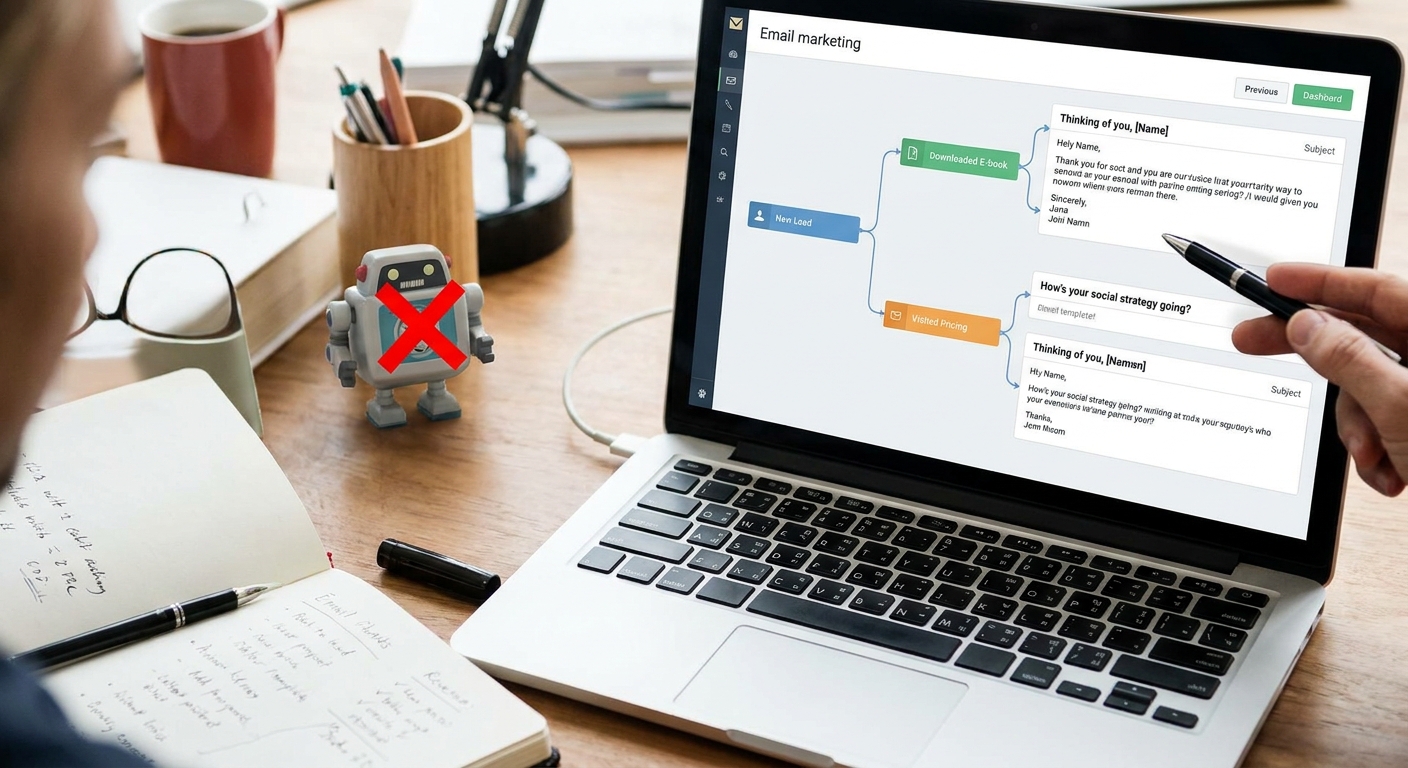
- Someone who downloads your e-book on social media strategy for beginners is on a very different journey than someone who visited your high-ticket web design services page three times this week.
- Someone who attended your webinar about financial planning for freelancers has a different immediate need than someone who just signed up for your general newsletter.
This simple shift from demographic data to behavioral data ensures your message is always, always relevant to their specific interests and where they are in their journey with you. My personal rule of thumb is this: every action a user takes is a whisper about what they need next. Our job is to use technology to listen closely.
Foundation #2: The ‘Choose Your Own Adventure’ Follow-Up
Alright, so once we have our segments, we get to add the real magic. This is what I like to call the ‘brain’ behind the whole operation: crafting a dynamic conversation with conditional logic.
Now, don’t let the term ‘conditional logic’ scare you. It’s really just a set of simple ‘if-then’ rules that make your automation intelligent and responsive. It turns a one-way broadcast into a two-way dance.
Let me give you a few examples of how I use this in my own business:
- IF a contact clicks a link in an email about my social media management package, THEN they are automatically sent a follow-up email 24 hours later with a powerful case study for that exact service.
- IF someone doesn’t open that first email after three days, THEN the system automatically sends a follow-up with a completely different, maybe more intriguing, subject line to try and catch their attention.
- IF a user visits the checkout page for a course but doesn’t buy, THEN they get an email a few hours later asking if they had any questions, maybe even featuring a few key testimonials to overcome last-minute hesitation.
See what’s happening here? You’re creating a responsive, ‘choose-your-own-adventure’ experience for them. Their actions dictate what they see next. It’s the polar opposite of blasting the same generic message to everyone on your list.
Foundation #3: Remember There’s a Human on the Other End
This brings us to our final, and arguably most important, piece. All the smart tech and clever logic in the world means absolutely nothing if the message itself feels cold.
My unbreakable rule for nurture emails is to write like I’m talking to a single person, a friend or colleague, over coffee.
Instead of stuffy, formal marketing speak like “We would like to inform you of an opportunity…”, try something more like, “Hey, I thought you might find this interesting…”. Using a friendly, conversational tone makes your message feel like a genuine recommendation, not a sales pitch.
I also love to end my automated emails with a genuine question that encourages a reply. Not a generic “Let us know if you have questions!”, but something specific, like:
- “Was this guide helpful for you?”
- “What’s your single biggest challenge with [topic] right now?”
This simple act opens a conversation and reminds them there’s a real, caring human being on the other side of the screen. When someone replies, you’ve successfully used automation to spark a manual, one-to-one connection. That’s the goal!
Oh, and here’s a pro tip from my own playbook: the emails that get the most engagement are often the ones that look like personal messages. I’m talking about simple, plain-text style emails—not big, flashy newsletters with tons of images. It cuts through the noise and feels more intimate, more like a real conversation.
Tying It All Together: From Robot to Relationship Builder
So, to wrap it all up, the three pillars for making automation feel human are:
- Smart Segmentation: Grouping people by their actions and interests.
- Conditional Logic: Using ‘if-then’ rules to create a responsive, relevant journey.
- Conversational Copy: Writing like a human, to a human.
What I always come back to is this: the goal isn’t to fake a connection. It’s to use these incredible tools to create the space for a real one to happen. Automation handles the heavy lifting, which frees you up to be fully present and human for the right people at exactly the right time.
Speaking of being present, next week we’re tackling a big one that I know many of you have asked about. In episode 42, we’re diving into ‘Video for the Camera-Shy Founder: 3 Formats That Don’t Require You to Be the Star’.
You’ll find it’s the perfect way to use the power of video in your marketing, even if you absolutely hate the idea of being on camera. I can’t wait to see you then!
As always, thanks for tuning in. If you have any questions about setting up your own nurture sequences, drop them in the comments below—I’d love to help out!