
Hello and a very warm welcome back to the blog! I am so glad you’re here. Today, we are tackling a big one, a topic that I see cause so much unnecessary stress for business owners: the re-engagement campaign.
Let me paint a picture for you, and tell me if this sounds painfully familiar. You’ve worked tirelessly to build your email list. You’ve created lead magnets, run ads, and dutifully collected thousands of email addresses. But over time, you notice something… a huge chunk of that list has gone quiet. Crickets. Your open rates start to slide, and you look at that big number of subscribers and feel a little bit defeated.
If that’s you, I want you to take a deep breath and reframe your thinking entirely. That quiet list isn’t a failure. It’s not a graveyard of lost leads. It’s a sleeping asset, a treasure chest of potential just waiting for you to find the right key.
The big question we’re exploring today is this: how do you wake those subscribers up and turn them back into engaged fans and potential customers, all without being annoying or spammy? Well, that’s exactly what we’re going to do. I’m going to give you my simple, actionable blueprint for breathing new life into your list.
First Things First: Why Bother with a Sleeping List?
Before we dive into the ‘how-to’, I always find it’s so important to ground ourselves in the ‘why’. Why should you invest time and energy into this? Isn’t it better to just focus on getting new subscribers?
In a word: no. It is far, far more cost-effective to reactivate someone who has already raised their hand and said, “Yes, I’m interested in you,” than it is to go out and find a complete stranger.
Think of it like tending a garden. You wouldn’t ignore the plants that have already sprouted just to focus on planting new seeds, would you? Of course not! You’d water them, give them some attention, and help them flourish. Your dormant email list is the same. These people already know your brand. They just got busy, distracted, or maybe your emails just fell off their radar. A gentle nudge is often all it takes.
When we run these campaigns well, I consistently see three incredible wins:
- A Boost to Your Reputation: Email providers like Google and Outlook are watching. When you send emails to a bunch of unengaged accounts, they see it as a negative signal. By cleaning your list and re-engaging people, you tell them you’re a responsible sender. This boosts your deliverability, meaning more of your future emails will actually land in the inbox.
- Metrics You Can Actually Trust: A list full of inactive subscribers will drag your open and click-through rates into the mud. It gives you a skewed, depressing view of your performance. After a re-engagement campaign, your metrics suddenly become much more accurate and reflect the true health of your engaged audience.
- Rediscovered Warm Leads: Best of all, you bring people back into your world! You’ll rediscover potential customers who were genuinely interested but just needed a reminder. It’s a direct path to new sales and renewed brand loyalty.
It’s a true win-win-win.
Step 1: Identify and Segment Your Sleepers
Okay, let’s get practical. You can’t wake someone up if you don’t know who’s asleep. Our first step is all about precise identification.
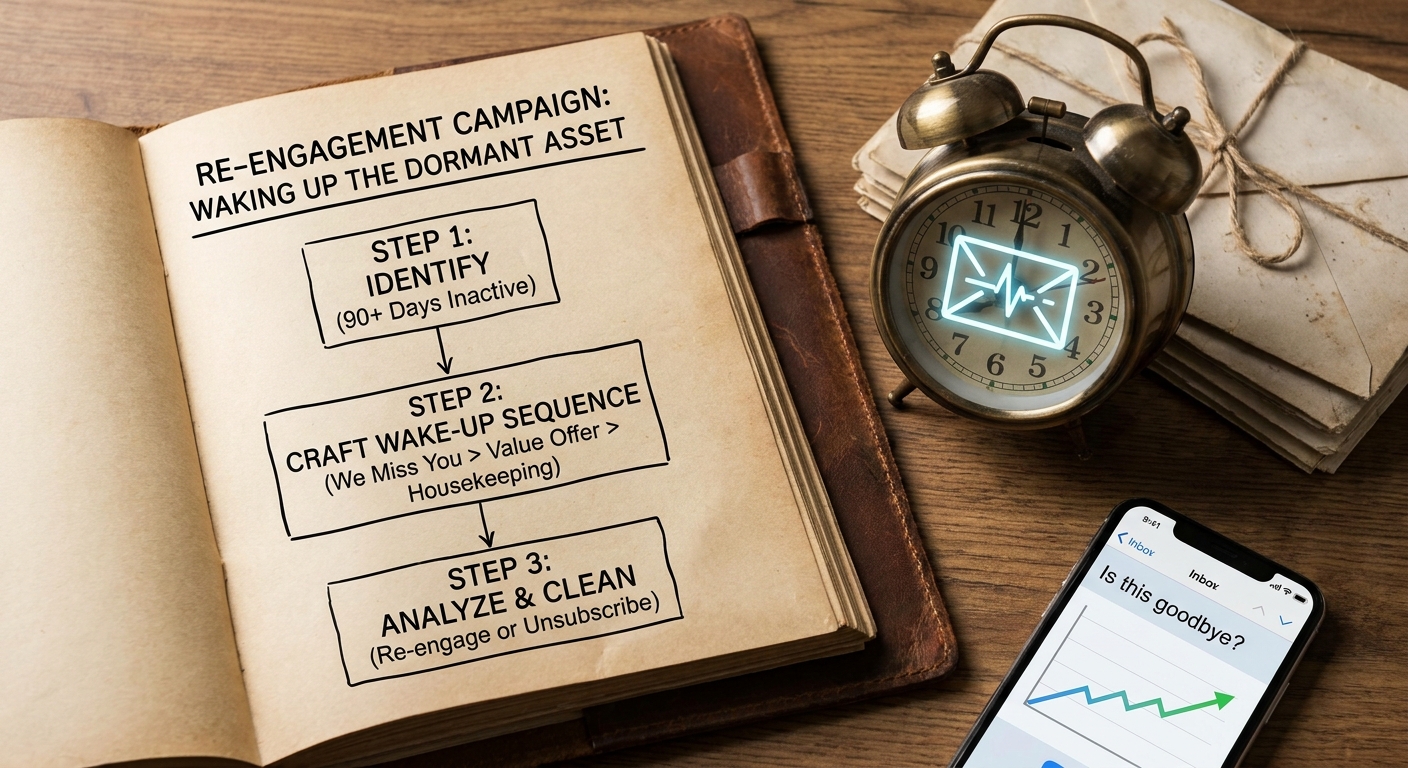
You need to define what ‘inactive’ means for your business. There’s no universal answer, but my personal rule of thumb is to start with anyone who hasn’t opened or clicked an email in the last 90 days. This is a great baseline for most businesses.
However, if you have a much longer sales cycle—say, you sell high-ticket consulting or luxury goods—you might find that stretching this to 180 days makes more sense. The key is to choose a timeframe that feels right for your customer journey.
Once you have your definition, it’s time to head into your email marketing software (whether that’s Mailchimp, ConvertKit, Klaviyo, or something else). You’re going to create a new segment or tag for these subscribers.
Don’t let the technical term scare you! It’s usually as simple as setting a filter. You’ll look for a rule like:
- Subscriber has not opened any campaign in the last 90 days.
- AND subscriber has not clicked any campaign in the last 90 days.
This step is so crucial because it separates the strategic work we’re about to do from the lazy ‘spray and pray’ approach. We aren’t blasting our entire list. We are performing a surgical operation, targeting only the right people without bothering our happy, engaged fans.
Step 2: Craft the Perfect Wake-Up Sequence
Alright, you’ve identified your sleeping subscribers. Now, how do we gently wake them up? My unbreakable rule here is to lead with value and respect, not a hard sell.
I’m a huge fan of a simple, automated three-email sequence. It’s powerful, effective, and doesn’t overwhelm anyone.
Email #1: The Gentle Nudge (‘We Miss You’)
The goal here is pure and simple: get a single click to signal that they’re still listening. The tone should be light, friendly, and inquisitive.
- Killer Subject Lines: ‘Is this goodbye?’, ‘Still interested in [Your Topic] tips?’, or a simple ‘Checking in…’
- The Body: Keep it short and sweet. Acknowledge that it’s been a while. You could say something like, “Hey [First Name], we haven’t heard from you in a while and we wanted to check in. Do you still want to receive our weekly marketing tips? Just click below to let us know!” This isn’t about selling; it’s a simple question.
Email #2: The Clear Value Offer
If the first email didn’t get a response, it’s time to remind them why they signed up in the first place. This is where you re-state your value proposition with a compelling offer.
- Killer Subject Lines: ‘An exclusive gift for you’, ‘Was it something we said? Here’s 20% off’, or ‘A free guide we thought you’d love.’
- The Body: Offer them something irresistible that they can’t get anywhere else. This could be an exclusive discount, a valuable free resource (like an ebook or a template), or early access to a new product. You’re reminding them that being on your list comes with real perks.
Email #3: The Housekeeping Email (‘The Graceful Goodbye’)
For anyone who is still silent, we send one final email. This one is all about transparency and respecting their inbox.
- Killer Subject Lines: ‘We’re cleaning house!’, ‘Final chance to stay on the list’, or ‘Confirm your subscription to keep hearing from us.’
- The Body: Be direct and honest. Let them know you’re cleaning up your email list to make sure you’re only sending content to people who truly want it. Say something like, “To save your inbox from clutter, we’re removing inactive subscribers from our list. If you’d like to stay, please click the button below. Otherwise, no action is needed, and we’ll say a graceful goodbye.” This shows immense respect and often gets a surprising number of last-minute clicks.
Step 3: Analyze the Results and Clean House
Your wake-up sequence has run its course. Now for the final—and most satisfying—step.
First, let’s celebrate the wins! Go into your email reports and see who’s back in the game. You’ll want to identify anyone who:
- Opened or clicked any of the three emails.
- Specifically clicked the ‘Yes, I want to stay subscribed!’ link.
- Took you up on your special offer.
These are your people! My process is to create a new tag for them, something like ‘Re-engaged – [Date]’. Then, you can remove them from the ‘inactive’ segment and move them back over to your main, active list. Welcome back!
Now, for the part that feels hard but is actually one of the biggest wins you can get for your marketing: for everyone who didn’t respond at all… we unsubscribe them.
I promise you, this is a profoundly good thing. It’s like pruning a tree; you’re removing the dead branches so the healthy ones can thrive. You are creating a leaner, meaner, more powerful email list that saves you money on your subscription and skyrockets your reputation with email providers.
Always remember: a smaller, highly-engaged email list is infinitely more valuable than a large, silent one. Quality trumps quantity, every single time.
So, to wrap it all up, the process is simple:
- Identify your inactives with a clear definition.
- Execute a strategic, three-part wake-up sequence.
- Analyze the results and courageously clean out the unresponsive contacts.
Follow these steps, and you’ll transform that sleeping asset into one of your most powerful marketing channels.
Thank you so much for tuning in today! I hope you found this blueprint helpful. If you have any questions or want to share your re-engagement results, please drop a comment below—I’d love to hear from you.
Join me next week as we tackle a crucial mindset shift in an episode titled, ‘The Mental Shift: From “Marketing as a Cost” to “Marketing as an Investment”.’ It’s a perspective change that can unlock serious growth for your business.
Until then, take care and happy marketing!