
Hello and welcome back! It’s great to have you here for another episode of Successful Community Building for Sales and Influence. Today, we’re tackling one of the most persistent, soul-crushing challenges that every single creator, founder, and community builder faces: the content treadmill.
Let’s be brutally honest for a moment. That feeling of staring at a blank content calendar, knowing you need to publish something but having absolutely no idea what? It’s a nightmare. I’ve been there more times than I can count, trying to wring one more idea out of my over-caffeinated brain. It is absolutely exhausting.
But what if I told you that you’re sitting on a goldmine of proven, high-engagement content ideas right now? What if your best, most resonant content isn’t something you have to invent, but something you simply have to uncover? The truth is, your community members are creating this content for you, every single day, in their questions, their wins, and their debates.
In this episode, I’m going to hand you the exact framework I use to turn those raw, organic member discussions into a powerful, self-sustaining content machine. It’s time to get off the hamster wheel and start building an engine. Let’s get to it.
Mining for Gold in Your Own Backyard
Your community platform—whether it’s a bustling Slack, a vibrant Discord, a focused Circle community, or a classic forum—is a treasure chest. The trick is knowing what you’re looking for. You have to learn how to spot the glint of gold amongst all the daily chatter. Over the years, I’ve trained myself to scan for a few key signals.
Here’s what I’m always on the lookout for:
-
The Echoing Question: You know the one. The same question, phrased slightly differently, that pops up again and again. Someone asks, “What’s the best CRM for a solo consultant?” on Monday, and by Friday, two other people have asked a variation of the same thing. This isn’t an annoyance; it’s a flashing neon sign. It’s a blog post, a video, a webinar begging to be created. It’s a clear signal of a widespread pain point that your audience desperately wants solved.
-
The High-Energy Thread: This is when a post just blows up. Someone shares a controversial opinion, a tough problem, or a novel strategy, and suddenly there are dozens of replies, reactions, and threaded conversations. That energy is pure gold. It means you’ve struck a nerve. The topic is emotionally resonant and has multiple points of view, which is the perfect fodder for rich, multifaceted content.
-
The Unsolicited Win: My personal favorite. This is when a member posts something like, “Whoa, I tried that outreach strategy you shared last month and just landed my biggest client ever!” or “Finally hit 10k followers using the framework from the last workshop!” This isn’t just a feel-good moment; it’s a mini-case study, a powerful piece of social proof. Screenshot it immediately (with permission, of course!).
💡 My Process: My system for capturing this is dead simple, and you can steal it. I have a private Slack channel called
#community-insights. My team and I have one rule for this channel: no chatter. We just drop in links to threads and screenshots of insightful comments or wins. It’s our treasure chest, and we fill it every single day. When it’s time to plan content, this is the very first place we go.
From Raw Conversation to Polished Asset
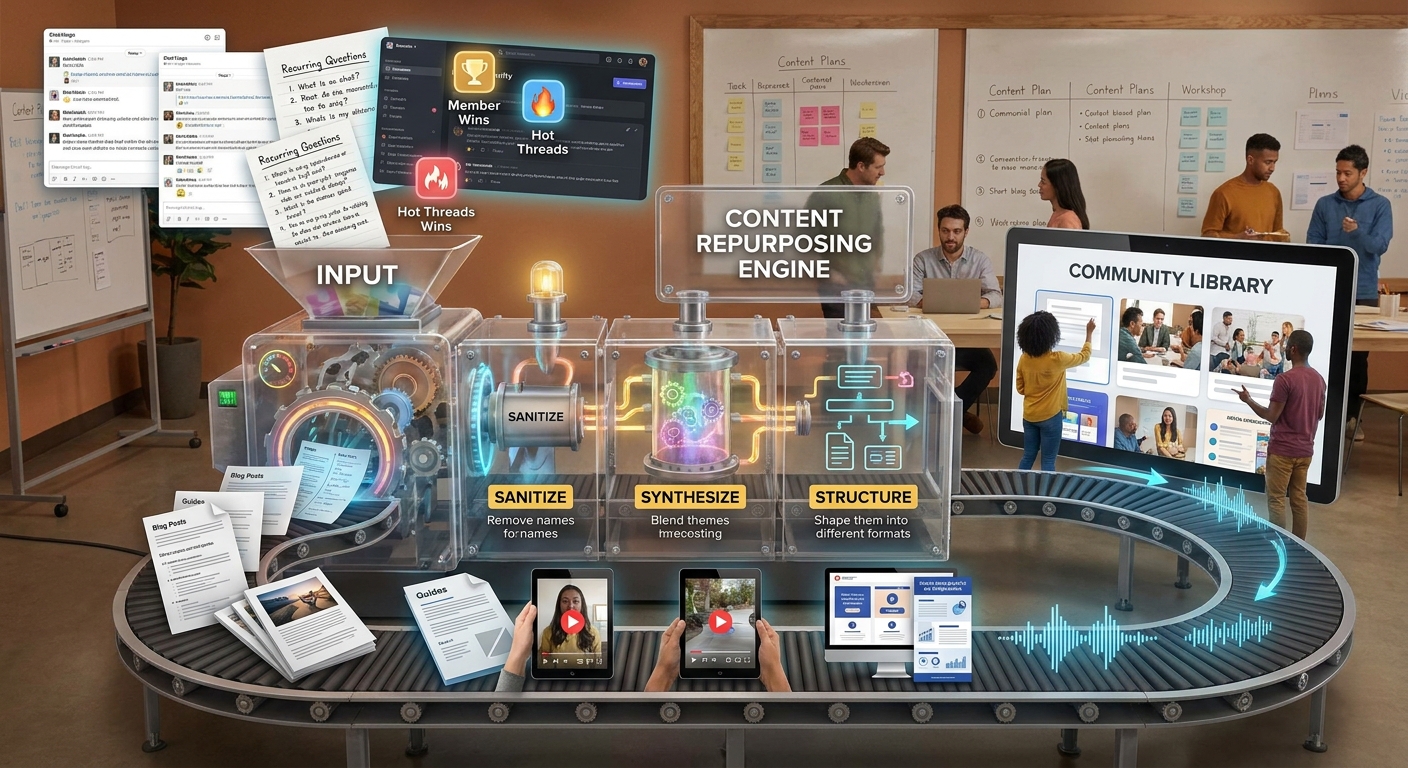
Okay, so you’ve collected the raw gold. Now what? You can’t just copy and paste a messy Slack thread and call it a blog post. The next step is to refine that raw material into something polished, valuable, and easy to consume. My process has three parts: Sanitize, Synthesize, and Structure.
-
First, I sanitize it. This is my non-negotiable first step. I immediately strip out all personal identifying information—names, avatars, company details, etc. Member privacy and trust are sacred. You can’t build a great community by making people feel like their casual questions will be put on blast. I usually credit the idea with a collective nod, like, “A great question came up in our community last week…” This gives them credit and makes them feel included without putting anyone on the spot.
-
Next, I synthesize. I’m not just a reporter transcribing a conversation; I’m a strategist looking for the deeper theme. If five people are asking for cold-calling scripts, the theme isn’t just “scripts.” The deeper theme is “overcoming call reluctance” or “building confidence in outreach.” My job is to zoom out, understand the why behind the what, and pull all the best insights, tips, and perspectives from the thread into a single, cohesive narrative.
-
Finally, I give it structure. Raw insight is great, but structured insight is actionable. I take the synthesized ideas and pour them into a familiar content format. Does this work best as a Q&A post? A listicle of the top 5 solutions? A step-by-step “how-to” guide? A short, punchy video? Giving it a clear format makes the insight digestible and helps your audience immediately understand how to apply it.
The Multiplier Effect: One Idea, Infinite Content
Now we get to my favorite part. This is the step that separates the content grinders from the content strategists. If you’re not doing this, you are leaving so much value on the table. One great community conversation should never equal just one piece of content.
Let me paint a vivid picture. A few weeks back, a thread in our community exploded with a debate about the “best tools for project management as a freelancer.” It was a fantastic, high-energy discussion.
Instead of just writing one article, here’s how we applied the multiplier effect:
-
The Pillar Piece: First, we created the big one. A comprehensive blog post titled, “The Top 5 Project Management Tools for Freelancers, Voted by Our Community.” This became the central, canonical resource.
-
Atomize into Video: We then created five short-form videos for TikTok and Instagram Reels. Each video was a 60-second deep-dive into one of the tools from the list.
-
Create a Thread: We repurposed the key points into a high-value social media thread, with each post offering a quick tip or key feature for each tool.
-
Design an Infographic: Finally, we had our designer create a simple, shareable visual comparing the top three tools on price, key features, and user ratings. Perfect for Pinterest and LinkedIn.
Look at that. One community conversation became a pillar blog post, five videos, a written thread, and an infographic. That’s eight distinct pieces of content from a single idea. That’s how you build an engine, not a hamster wheel.
My Unbreakable Rule: Always Close the Loop
This final step is the most critical, and it’s the one almost everyone skips. Once you’ve created all this amazing content, you absolutely must share it back into the community where the idea originated.
Don’t just let it sit on your blog. Post a link directly in your community with a simple, genuine message. I’ll write something like:
“Hey everyone! That fantastic discussion we had last week about project management tools was so insightful, it inspired us to create this definitive guide based on all your amazing contributions. A huge thank you to everyone who chimed in!”
This isn’t just being polite; it’s profoundly strategic. It accomplishes two things:
-
It makes your members feel seen and heard. It shows them that their contributions matter and that you are genuinely listening. This builds immense loyalty and encourages more high-quality participation in the future.
-
It creates a canonical, easily-searchable resource. The next time a new member asks that same question, you or any other member can instantly reply with a link to the definitive guide you created together. The loop is closed.
This transforms the dynamic from extraction to collaboration. You’re not just taking their ideas; you’re co-creating a library of collective knowledge. It’s a beautiful, symbiotic cycle.
Your Turn: Stop Grinding and Start Listening
The real takeaway here is beautifully simple: your community is an endless wellspring of incredible content, but only if you stop talking long enough to truly listen.
So please, I’m begging you, stop the content grind. Give yourself a break from the tyranny of the blank page. Your only job this week is to go into your community—not to post, but to listen. To read. To observe. Learn to spot the signals, build a simple system to capture them, convert those conversations into high-value assets, and for goodness sake, always share the finished product back with the people who inspired it.
The answers you’re looking for are already there.
Coming Up Next Week…
Join us next week for Episode 28: Crowdfunding a Community Project: Using Kickstarter & Patreon for Shared Goals, where we’ll dive into mobilizing your members to actually fund your collective ambitions. It’s a powerful one you won’t want to miss!
As always, I’d love to hear from you. Drop a comment below—have you ever tried this? What’s one recurring question in your community that could be your next piece of content?