Hello and a very warm welcome back to the blog! I’m so glad you’re here for Episode 30 of The Busy Business Owner’s Guide to Marketing.
Let’s be honest for a second. Have you ever commissioned—or maybe even painstakingly written—a giant, multi-page marketing plan? You know the one I’m talking about. It’s got charts, fifty pages of market analysis, and looks incredibly impressive sitting in a thick, glossy binder. But then… it just sits there. Gathering dust on a shelf, a monument to good intentions but a ghost in your day-to-day operations.
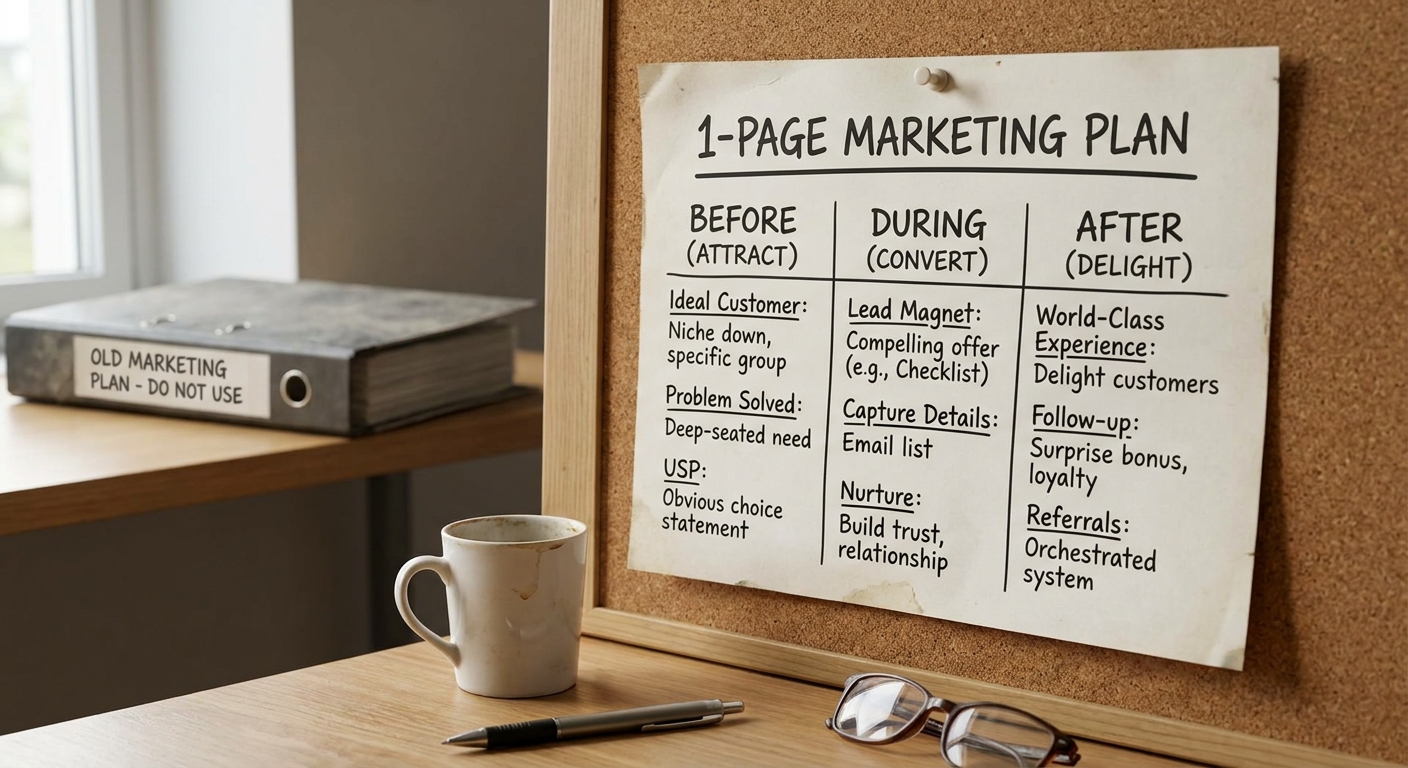
I see this happen all the time. It’s a painfully common story. Those exhaustive plans are often too theoretical, too dense, and too intimidating to be genuinely useful. So today, we’re going to fix that. We’re going to trade that dusty binder for a single sheet of paper. We’re diving into the game-changing magic of the 1-Page Marketing Plan. This is all about ditching the fluff, achieving ultimate clarity, and getting your entire strategy down onto a single, powerful, and actionable page you’ll actually use.
Why One Page is Pure Genius
It sounds almost too simple to be effective, doesn’t it? But that’s precisely where its power lies. A traditional marketing plan is like an encyclopedia—it contains a universe of information, but you rarely open it unless you’re looking for something very specific. A one-page plan, on the other hand, is a roadmap. It’s your compass, your guide, the thing you glance at every single day to make sure you’re still heading north.
What I absolutely love about this approach is that it forces brutal honesty. There is simply no room for jargon, vague goals, or vanity metrics. You have to distill your entire business strategy down to its most essential, potent components.
Let me paint a vivid picture for you. I once worked with a small, independent retailer who was struggling to make their ad budget work. They had a 40-page plan that talked about “synergizing market presence” and other corporate-speak. It was useless. When I challenged them to get it all onto one page, the real work began. They had to boil everything down, and in doing so, they were forced to finally—finally—define their ideal customer. Not just “women aged 25-45,” but “Sarah, a 32-year-old working mom who values sustainable products but is too busy to do hours of research.”
That single piece of clarity transformed their entire business. Their ad copy changed, their product selection sharpened, and their sales started climbing. Their one-page plan became a living guide they pinned to the wall in their office. It’s all about focusing on action over theory.
Pillar 1: The ‘Before’ Stage — Attracting Your Ideal Customer
Alright, let’s get practical. The first section of your one-page plan is what I call the ‘Before’ stage. This is all about your prospect. What is their life like before they find you? And how do we get their attention?
My unbreakable rule here is to stop trying to be everything to everyone. The temptation for a small business is to cast the widest net possible, but that’s like trying to catch a specific fish using a net with giant holes. You just end up wasting energy.
Instead, I want you to niche down. Become a specialist. Think of it this way: if you have a serious heart condition, you don’t go to a general practitioner. You go to a cardiologist. The cardiologist can charge more, gets more respect, and attracts the exact patients they are best equipped to help. That’s what you need to be for your customers.
This process forces you to get crystal clear on two things:
- Who you serve: Your ideal customer avatar.
- What deep-seated problem you solve for them: Not the surface-level problem, but the real, emotional pain point.
Once you know that, crafting a compelling message becomes a thousand times easier. This is where we create your Unique Selling Proposition (USP). Your USP is that one simple, powerful statement that makes you the obvious and only choice for your ideal customer. It’s the answer to their question: “Why should I buy from you and not your competitor?”
Pillar 2: The ‘During’ Stage — From Prospect to Lead
So, you’ve nailed your message and you’re starting to get attention. Fantastic! Now we move into the ‘During’ stage. This is where we capture that interest and convert a curious prospect into a genuine lead.
Think of this stage like dating. You wouldn’t ask someone to marry you on the first date, right? That’s what going straight for the sale feels like to a new prospect. It’s too much, too soon. Instead, you need to build a bridge of trust. My personal favorite way to do this is with a compelling offer—what we marketers call a lead magnet.
A lead magnet is a valuable piece of information or a special offer you give away in exchange for their contact details (usually an email address). It doesn’t have to be complicated! It could be a simple PDF guide, a checklist, a free template, or a discount code. The key is that it has to be irresistibly useful to your ideal customer.
I worked with a financial advisor whose lead magnet was a game-changer. Instead of just running ads that said “Book a free consultation,” he created a downloadable PDF called the ‘5-Point Retirement Readiness Checklist.’ He used targeted ads to get it in front of people in their late 40s and 50s. It was a massive success because it offered immediate value and solved a small part of their problem right away. It started a relationship.
Once you have their email, you can begin a nurturing process. This is a series of automated emails that continue to provide helpful content, build trust, and gently guide them toward making a purchase. It’s about being their trusted guide, not a pushy salesperson.
Pillar 3: The ‘After’ Stage — Creating Raving Fans
Now for the final and, honestly, the most tragically forgotten part of the marketing journey: the ‘After’ stage. So many businesses pour all their energy into getting the sale, and the second the credit card is charged, they stop marketing to that person. This is a huge mistake. In fact, I’d argue this is where the real money is made.
The ‘After’ stage is all about delivering a world-class experience that turns a one-time buyer into a loyal, repeat customer and, ultimately, a raving fan.
My personal rule of thumb is to have a concrete plan to delight your customers after the purchase. How can you exceed their expectations? This could be as simple as:
- A personalized, handwritten thank you note in their package.
- A follow-up email a week later checking in to see how they’re enjoying the product.
- A surprise bonus or small gift with their second order.
- A simple, effective loyalty program.
This is how you dramatically increase your Customer Lifetime Value (CLV) and turn a single transaction into a long-term, profitable relationship. And the ultimate goal here? An orchestrated referral system. When you create true fans who feel seen and valued, they become your best salespeople. They are your volunteer marketing team, telling their friends and family all about you.
Remember, marketing doesn’t stop at the sale; that’s where the real magic begins.
Tying It All Together on One Page
So, there you have it. The three simple, powerful pillars of your marketing plan: the Before stage to attract prospects, the During stage to convert them into leads, and the all-important After stage to create loyal fans.
This simple structure is the fastest way I know to move from feeling overwhelmed and confused to having absolute clarity on the actions you need to take every single day. These three stages become the columns of your one-page plan, with a few key points under each.
To help you get started on this journey to clarity, I’ve put a free 1-Page Marketing Plan template on our website for you to download. Just head over to the resources section and grab your copy. It’s my gift to you!
I hope this has been as illuminating for you as it has been for so many of the business owners I’ve worked with. Join me next time, where we’ll be diving deep into what I believe is the most underrated and powerful tool for any local business: your Google Business Profile. You might be shocked to learn that this one free tool can actually outperform your paid ads, and I’ll show you exactly how to optimize it.
You won’t want to miss it! Until next time, keep marketing with clarity and passion. And as always, I’d love to hear your thoughts or questions in the comments below!