Hello and welcome back! It’s so good to have you here again.
Today, we’re diving into a topic that I am incredibly passionate about because it sits right at the intersection of community, validation, and action: crowdfunding.
Frankly, if you only see platforms like Kickstarter and Patreon as a way to get cash, you’re missing the entire point. I see them as the ultimate tool for engagement. It’s about turning passive followers into passionate co-creators.
The Core Difference: It’s the difference between asking people to buy a ticket for a cruise and asking them to help you build the ship, plank by plank. One is a transaction; the other is an adventure.
I’ve seen groups completely transform when they get this right. So let’s frame our conversation today around a single, critical question: How do you transform a shared idea into a funded, tangible reality that your community genuinely feels they own?
Why Crowdfunding is More Than Just a Piggy Bank
Look, anyone can go to a bank and try to get a business loan. And if you succeed, what do you get? Cash and a repayment schedule. End of story. It’s a cold, impersonal transaction.
Crowdfunding is entirely different. It’s a strategic move that pays dividends far beyond the money you raise. I see three core benefits that you simply can’t get from a bank:
1. The Ultimate Validation
This is my favorite part. You can run all the surveys and polls you want, but nothing—and I mean nothing—validates an idea like someone pulling out their wallet. It’s not just a “like” or a “follow.” It’s a tangible vote of confidence. It’s your community looking you in the eye and saying, “Yes, we believe in this so much that we’re willing to put our own money on the line to see it happen.” There is no clearer signal in the world.
2. It Forges Stakeholders
When someone contributes to your campaign, their psychology shifts. They are no longer just a member or a follower; they are an investor, a co-owner, a founder.
For example, I once worked with a gaming community that was tired of relying on laggy, unreliable third-party servers. They decided to crowdfund their own dedicated, high-performance hardware. Suddenly, every person who pledged twenty dollars wasn’t just a player anymore—they were an investor in the community’s future. They reported cheaters faster. They welcomed new members more enthusiastically. They cared more, because they literally owned a piece of the foundation.
3. It Creates an Unbeatable Narrative
The story is no longer, “I built this for you.” It becomes, “We built this together.”
That story is priceless. It generates organic buzz, deep loyalty, and a powerful sense of shared identity. It’s marketing you simply can’t buy, because it’s authentic and it’s born from a collective effort.
Choosing Your Arena: The Kickstarter Sprint vs. The Patreon Marathon
Okay, so you’re sold on the ‘why.’ Now you have to choose your arena, and let’s be clear: this is not a random pick. This is about strategically matching the tool to the job. It’s like choosing between a hammer and a screwdriver; both are useful, but you wouldn’t use a hammer to turn a screw.
My personal rule of thumb is to think of it this way:
-
Kickstarter is for the big, one-time event (The Sprint). It’s designed for a finite project with a clear beginning, middle, and end. Think: launching a new community app, funding a physical meeting space for your group, or producing a feature-length documentary for your members. Its all-or-nothing funding model is brilliant because it creates intense, unavoidable urgency. If you don’t hit your goal, no money changes hands. This lights a fire under your community to get the word out and ensure the project succeeds.
-
Patreon is the subscription model for your community’s lifeblood (The Marathon). This is the perfect tool for recurring, ongoing operational costs. Think: funding a community manager’s salary, paying for monthly premium software or server access, or covering the costs of producing a weekly podcast. It’s not about a single, explosive launch; it’s about creating a sustainable, predictable stream of support that allows your community to thrive over the long term.
Before you go any further, ask yourself that simple question: Is this a finite project or an ongoing operation? Your answer will point you to the right platform.
Your Pre-Launch Playbook: Setting the Stage for Success
So you’ve picked your arena. Fantastic. But listen to me carefully: the real work begins long before you hit that “launch” button. So many amazing ideas fall flat because their creators thought the launch day was the beginning. It’s not. It’s the climax of the first act.
My unbreakable rule is this: Never, ever, launch a campaign to a cold audience. Here’s my process for warming them up:
-
Nail the ‘Why’: Your campaign page isn’t a spec sheet; it’s an emotional pitch. The centerpiece of this pitch is a high-quality video that clearly and passionately explains your mission. Why does this project need to exist? What problem does it solve? What future does it create for your community? Don’t cheap out here. A shaky, poorly-lit phone video sends a message that you aren’t serious. Invest in making it look and sound professional.
-
Design Irresistible Rewards: Here’s a little secret—you’ll often find that selling status works far better than selling stuff. While a t-shirt is nice, what people really crave is access and recognition. My favorite tiers are those that offer real exclusivity: a private Q&A session with the project leads, their name credited as a “Founding Member” on the website, or access to a private channel where they get behind-the-scenes updates. Make them feel like an insider, a true partner in the journey.
-
Activate Your Core: This is the most critical part. Your most dedicated, passionate community members are your vanguard. You need to reach out to them before you launch, share the plan, and get their commitment to pledge within the first 48 hours. This initial momentum is powerful social proof. A campaign that hits 30% of its goal on day one looks like an inevitable winner. It creates a bandwagon effect that pulls everyone else in. A campaign that’s sitting at 2% after two days feels… well, a bit sad.
You’re Funded! Now the Real Relationship Begins
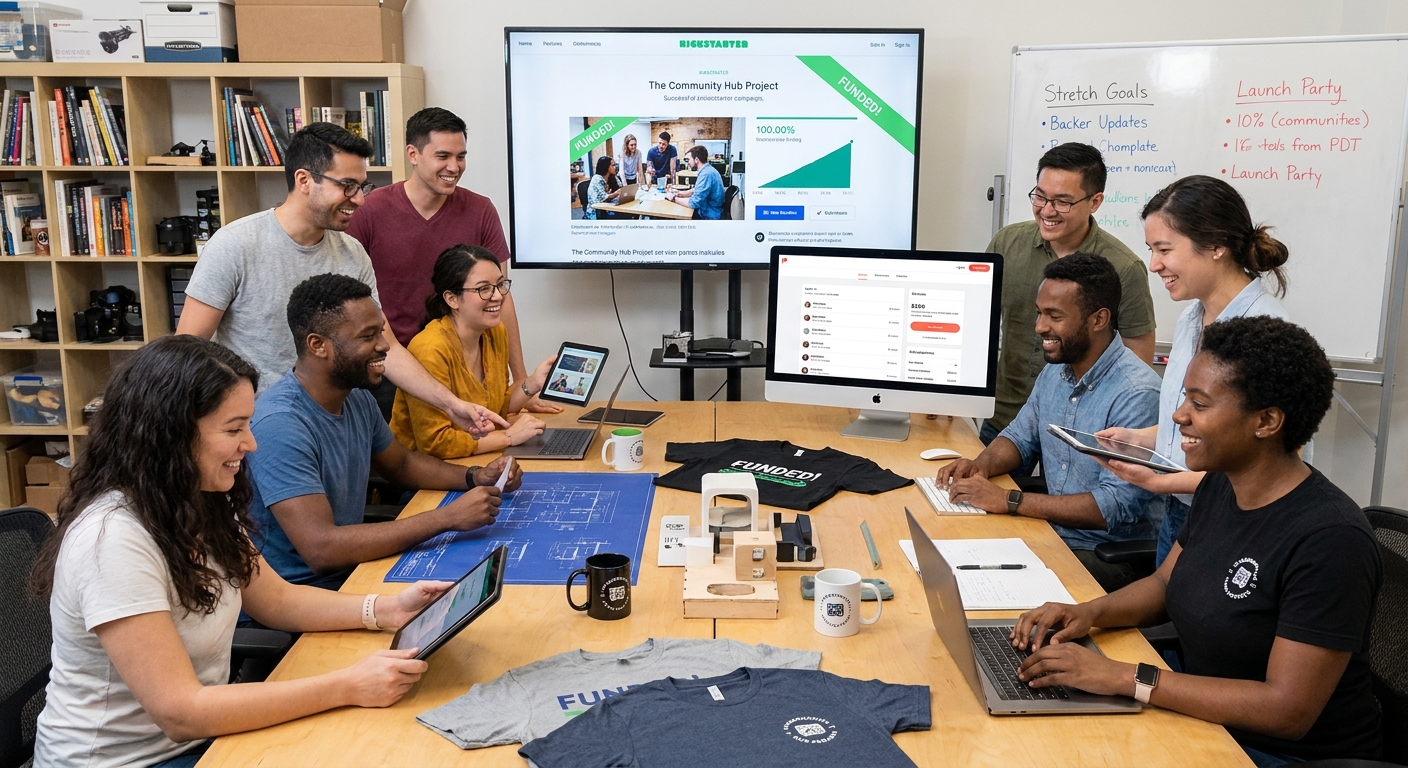
Okay, the countdown hit zero, and you crushed your funding goal. Pop the champagne, celebrate with your team, and take a deep breath. Because the real work—the work of building trust—starts right now.
So many creators make the painful mistake of going quiet after the campaign ends, only to reappear months later when it’s time to deliver. Don’t do this. Your backers didn’t just buy a product; they invested in a promise. Now you have to show them the process.
A relentless commitment to communication is non-negotiable. Set a regular update schedule—once a week, every two weeks, whatever—and stick to it. Even when the news is bad. Especially when the news is bad.
Case Study: The Transparent Pivot
I once coached a team whose key manufacturing partner went out of business, delaying their production by three months. It was a potential disaster. Instead of hiding, they posted a detailed update the very next day.
They explained exactly what happened, what their new plan was, and what the new timeline looked like. They were honest, transparent, and respectful. And you know what? They didn’t lose a single backer. In fact, their comment section was filled with messages of support, because they treated their backers like partners, not just customers.
When you finally deliver the rewards, remember that you’re not just closing a transaction; you are solidifying a relationship for life. A fantastic fulfillment experience is your chance to convert a one-time backer into a lifelong advocate for you and your community.
The Journey is the Reward
Let’s wrap this up. What I really want you to take away today is that this isn’t just about money. Crowdfunding is a powerful engine for validation, mobilization, and co-creation.
But it requires you to be deliberate. Choose your platform wisely—Kickstarter for the big project, Patreon for the long haul. And please, don’t you dare launch cold. That pre-launch groundwork to warm up your community is everything. The communication you maintain after you’re funded? That’s what turns a successful campaign into a legendary community.
Thanks so much for tuning in and sharing this space with me. It’s an honor to be on this journey with you.
Next Time: Now that we know how to fund a shared goal, next time we’ll explore the science of why people join communities in the first place. Join me for Episode 29: The Psychology of Belonging: Leveraging Cialdini’s Principles for Cohesion.
What do you think?
What community project have you always dreamed of launching? Drop a note in the comments below—I’d love to hear about it!