
Hello and welcome back to The Busy Business Owner’s Guide to Marketing!
Today we’re diving into something that genuinely keeps me up at night—watching incredible business owners treat their marketing like an expensive monthly subscription they secretly wish they could cancel.
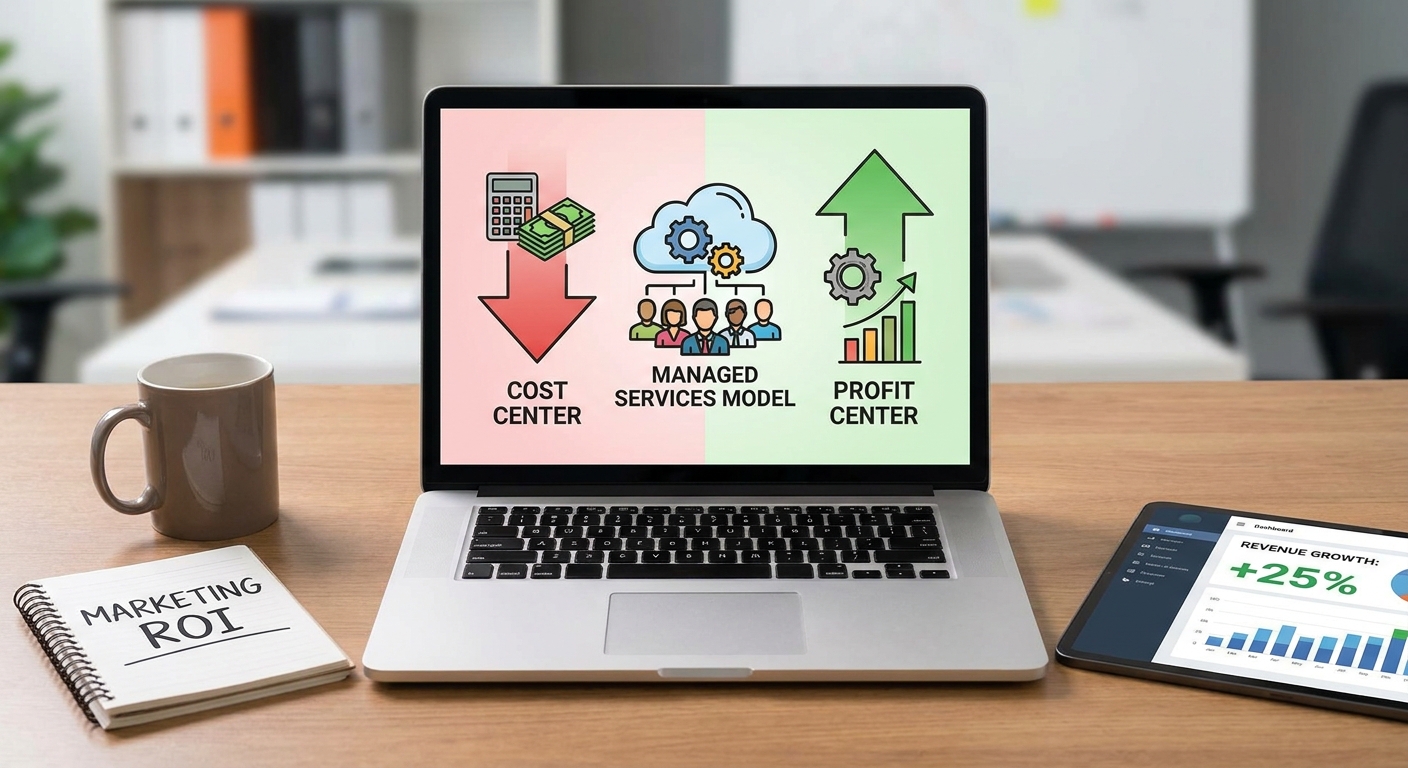
Episode 24 is all about The Financial Case for Managed Services and how to move your marketing from a dreaded cost center to a genuine profit center.
Let me paint a vivid picture. Imagine your business as a powerful ship sailing across the ocean. Marketing isn’t the fuel you’re burning. It is the sails. Yet most owners look at their marketing budget the same way they look at their office coffee machine—something that costs money and occasionally produces results.
Today I’m going to show you how to flip that thinking completely.
The “Cost Center” Trap (And Why It’s So Dangerous)
In business speak, a cost center is anything that creates expenses without directly generating revenue. For decades, marketing has been shoved into this category alongside things like HR and accounting.
You see the ad spend. You see the software subscriptions. You see the salaries. Your brain adds it all up and screams, “Expense.”
Here’s the painful part.
When cash gets tight (and we all know that moment), marketing is usually the first thing thrown overboard. It feels like the responsible decision. “We’ll just pause the ads for a couple months and pick it back up later.”
My friend, this is the business equivalent of turning off your car’s engine while driving on the highway to save gas. Yes, you’ve immediately stopped spending money. You’ve also immediately stopped moving.
I’ve watched this exact scenario play out too many times. A client gets nervous about cash flow, slashes their marketing budget, and three months later they’re wondering why the phone stopped ringing. The pipeline didn’t just slow down—it completely dried up.
The Managed Services Revolution
This is where managed marketing services become genuinely beautiful.
Instead of treating marketing like a sporadic expense, you create a strategic partnership with a dedicated external team for a fixed monthly investment. It’s predictable. It’s proactive. And most importantly, their success becomes directly tied to your growth.
Think about the three ways most businesses handle marketing:
- The In-House Hire: One person wearing ten different hats, with salary, benefits, software, training, and management overhead that easily exceeds $110k–$140k per year.
- Project-Based Freelancers: A revolving door of talent. Inconsistent quality. Constant onboarding. Feast-or-famine spending patterns.
- Managed Services: An entire specialized team—strategist, copywriter, designer, ads expert, analyst—for a predictable monthly fee that’s often less than a single senior employee.
The shift in mindset here is massive.
Suddenly you’re not asking, “How little can we spend this month?” You’re asking, “How do we maximize the return on this investment?”
Let’s Talk Real Numbers (This Is Where It Gets Fun)
Let’s run some honest math.
A solid senior marketing manager in most markets will cost you around $80,000–$95,000 base salary. Add benefits, payroll taxes, software licenses, training, and equipment and you’re looking at $115,000–$135,000 fully loaded.
Now let’s compare that to a typical managed services retainer—somewhere between $5,000 and $8,000 per month. For that investment, you’re not getting one talented person. You’re getting a full squad of specialists who already have systems, processes, and enterprise-grade tools.
Even better? They’ve seen your problems before. Many times. In multiple industries.
The efficiency difference is staggering. While your in-house marketer is still figuring out which email platform to use, the managed team is already executing a sophisticated, multi-channel strategy that’s been refined across dozens of clients.
The ROI Conversation (This Is My Favorite Part)
Here’s what I love most about this model.
When you work with the right managed services partner, their compensation isn’t tied to hours worked or deliverables produced. It’s tied to your results. That alignment changes everything.
I worked with a B2B services company that used to scrutinize every single ad expense like a hawk. Every month was a negotiation about why we needed to spend “that much.”
After switching to managed services, the conversation completely flipped. We stopped talking about cost and started talking about pipeline value. The question changed from “How much did we spend?” to “How many qualified opportunities did we create, and what’s the potential lifetime value?”
That, my friend, is the difference between a cost center and a profit center.
My Personal Rule of Thumb
Here’s my unbreakable rule: Marketing should never be evaluated on what it costs. It should be evaluated on what it creates.
If you’re spending $6,000 per month but generating $45,000 in tracked revenue with a healthy profit margin, you don’t have a marketing expense. You have a profit engine with a very respectable ROI.
The goal isn’t to spend less. The goal is to get more return on what you spend.
Making the Mental Shift
The most successful business owners I work with have one thing in common: they’ve stopped thinking of marketing as a department and started thinking of it as a growth system.
They want predictability. They want expertise. They want to focus on running their business while someone else obsesses over their marketing performance.
Managed services gives them exactly that.
You get to stop worrying about whether your marketing manager is burned out or whether your latest freelancer actually knows what they’re doing. Instead, you have a partner whose only job is to make your phone ring and your inbox fill with qualified leads.
Ready to Stop Feeding the Cost Center?
The truth is, marketing should be one of the highest-ROI activities in your business. When it’s done right, it doesn’t cost you money—it makes you money.
The managed services model isn’t perfect for every business. But if you’re tired of the revolving door of talent, inconsistent results, and the constant stress of wondering if your marketing is “working,” it might be the strategic shift you’ve been looking for.
You deserve to look at your marketing budget and feel excited instead of anxious.
Next week we’re tackling something that drives me a little crazy: “Broadcasting vs. Community Building – The Key to Organic Social Media Growth.” We’re going to talk about why shouting into the void doesn’t work anymore and how to build an audience that actually knows, likes, and trusts you.
You won’t want to miss it.
In the meantime, I’d love to hear from you. Have you made the shift from seeing marketing as a cost to seeing it as an investment? Drop your thoughts in the comments—I read every single one.
Until next time, keep building something worth marketing.
— Your Busy Business Owner’s Marketing Mentor