Hello and welcome back to The Busy Business Owner’s Guide to Marketing! I am so glad you’re here today.
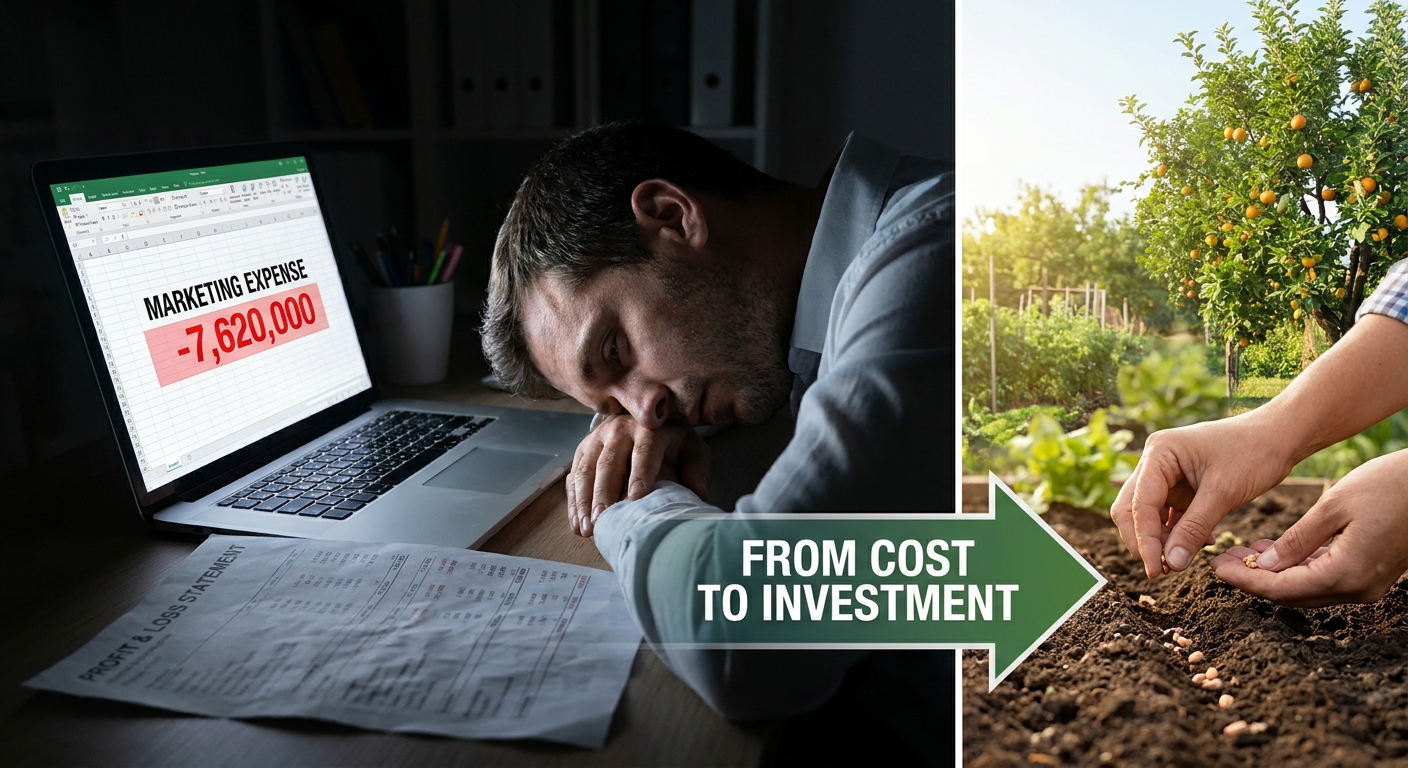
Let me paint a vivid, and perhaps painfully common, picture for you. It’s late. The kids are in bed, the house is quiet, and you’re staring at your profit and loss statement. Your eyes scan down the columns and land on that one line item: Marketing. It just looks like a big, red number, doesn’t it? A cost. A necessary evil, maybe. An expense bleeding out of the business.
What I see time and time again is business owners treating that number as just another bill to be paid, filed right alongside rent and electricity. Today, we’re going to tackle that feeling head-on. We are talking about a fundamental mindset shift that can change everything for your business: moving from seeing marketing as a cost, to truly, deeply viewing it as an investment.
You might just find that this one change is the foundation for all of your future growth. It’s the difference between just keeping the lights on and building a powerful asset that pays you back for years to come.
The ‘Cost Mindset’ Trap
So, what does this ‘cost mindset’ really look like in the wild? Well, it usually shows up as a few classic symptoms. See if any of these sound familiar:
- You find yourself always gravitating towards the cheapest option. The question isn’t ‘what will get me the best results?’ but ‘what’s the absolute least I can possibly spend?’
- When things get a little tight financially, the very first budget that gets slashed is marketing. It’s seen as a ‘nice-to-have’ luxury, not a core business driver.
- Your marketing efforts are sporadic and reactive. You only spend money when you’re having a slow month and panic sets in.
When you’re stuck in this mindset, you’re essentially treating marketing like your electricity bill. You pay it because you feel you have to, not because you expect it to actively go out and generate more revenue for you. It becomes a passive expense, not an active driver of growth. You’re just paying to keep the lights on, not to power a machine that brings new customers through the door.
The Quiet Danger of Playing Defense
The real danger of being stuck in the cost mindset isn’t a sudden implosion; it’s a slow, quiet stagnation. It’s a creeping invisibility.
While you’re trimming your marketing budget to save a few hundred dollars, your competitors are investing. They’re becoming the go-to name in your industry. They’re showing up everywhere your ideal customer is looking—on social media, in search results, in local mailers. And you, unfortunately, start to fade into the background.
When you become invisible, the only tool you feel you have left to compete with is price. This kicks off the dreaded ‘race to the bottom,’ where you find yourself constantly offering discounts just to make a sale. Why? Because you haven’t invested in building a brand that people actively seek out and are willing to pay a premium for.
This creates a vicious, reactive cycle. A slow month leads you to cut costs (marketing), which pretty much guarantees an even slower next month. You get trapped in a loop of short-term survival tactics instead of building a long-term strategy for success.
The Investment Mindset: Planting Seeds for Growth
But what if we looked at that marketing line item completely differently? What if, instead of a hole in your budget, you saw it as a seed-planting machine?
This is the investment mindset. The core idea is simple but profound: for every dollar you put into marketing, you have a reasonable expectation of getting more than a dollar back. That’s your Return on Investment, or ROI.
I love to use the analogy of a farmer. A farmer doesn’t look at a bag of seeds as a ‘cost.’ They see it as an investment in a future harvest. Your marketing efforts are those seeds. Some seeds might not sprout, and that’s okay. But with the right soil (your market), water (your message), and sunlight (your channels), many of those seeds will grow into fruit-bearing trees. Those trees are your loyal customers.
And the total value of all the fruit that one tree produces over its entire life? That’s what we call Customer Lifetime Value (LTV). An investment mindset means you’re not just thinking about the first sale; you’re thinking about building an entire orchard that will feed your business for years.
Your First Steps: From Guessing to Knowing
Okay, so this all sounds great in theory, but how do we actually start making this shift from ‘spender’ to ‘investor’? My advice is always to start incredibly simple. You don’t need a complex dashboard or expensive software on day one.
My unbreakable rule is this: Never spend a marketing dollar you can’t track.
Here’s how you can start applying that rule today:
- Just Ask the Question: Add one simple question to your sales or checkout process: “How did you hear about us?” This alone will start giving you amazing, real-world data about what’s working.
- Use Unique Codes: Running a small print ad or a social media campaign? Create a unique discount code for it (e.g., ‘FACEBOOK10’). If people use that code, you know exactly where they came from. No more guessing.
Suddenly, you’re not just throwing money into a void and hoping for the best. You’re gathering intelligence. You’re starting to connect the dots between your spending and your sales.
A Simple Test to Prove the Concept
Once you start tracking, the next step is to understand what a customer is actually worth to you. Let’s do some quick, back-of-the-napkin math.
Let’s say your average customer spends $50 per purchase. But you look at your data and realize your good customers don’t just buy once—they come back about five times over the next couple of years. That means a single new customer isn’t worth $50. They’re worth $250 ($50 x 5 visits).
Knowing that number changes everything. Suddenly, the idea of spending, say, $40 to acquire one of those customers doesn’t seem scary at all. It seems brilliant! You’re paying $40 to make $250.
This is where you can run a small, measurable test. You might put just $100 into a highly targeted Facebook ad campaign. If that campaign brings you three new customers, you’ve spent $100 to generate $750 in future revenue. You’ve just proven the concept, and that data gives you the confidence to scale your investment.
Taking the Driver’s Seat
So, let’s bring it all home. The one big shift I want you to consider this week is moving from that fear-based, cost-centric view of marketing to an empowered, ROI-centric one.
When you see marketing as an investment, you realize it isn’t just a bill to be paid; it’s a powerful engine for predictable growth. This single change in perspective empowers you to stop making reactive decisions based on fear and start making strategic choices based on real data.
It truly puts you in the driver’s seat of your business’s growth.
Thank you so much for joining me today. I hope this helps you look at that line on your P&L statement with a little more excitement and a lot less dread.
And speaking of strategy, be sure to join us next week for episode 49. We’re doing something special: it’s our ‘Marketing Ask Me Anything,’ where we’ll be answering your top 10 questions. It’s going to be a fun one!
Until then, keep growing. And as always, I’d love to hear your thoughts or questions in the comments below!