
Hello and welcome back, my friend!
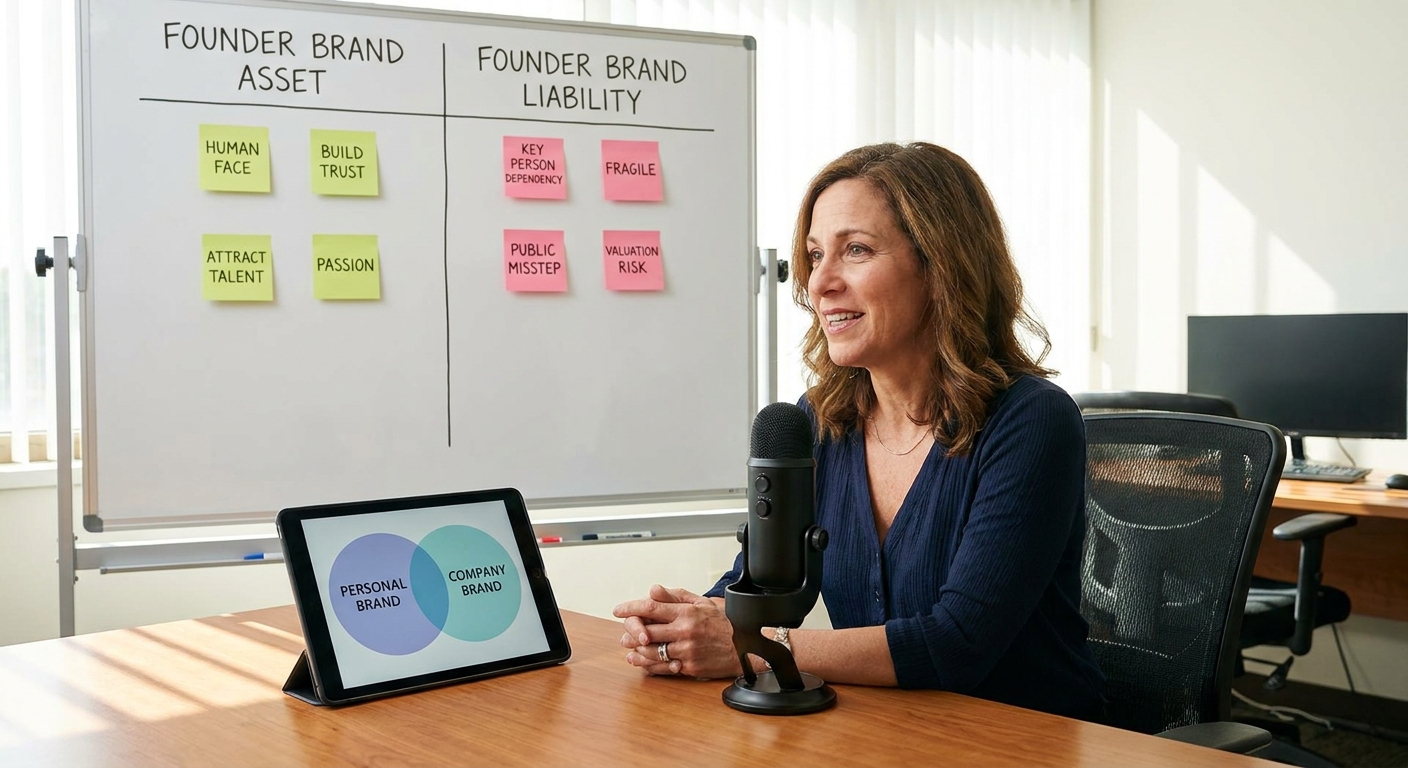
If you’ve ever wondered whether putting yourself front and center in your company’s marketing is brilliant or slightly terrifying, today’s episode is for you. We’re tackling one of the most common questions I get from busy founders: Is tying your personal brand to your company’s identity a strategic masterstroke or a dangerous gamble?
The answer, as with most things in marketing, is… it depends. But not in a vague, wishy-washy way. There are clear patterns I’ve seen across dozens of businesses, and today I’m going to walk you through them with practical eyes.
Let’s explore when your personal brand becomes rocket fuel—and when it quietly turns into a single point of failure.
The Massive Upside: Human Faces Beat Faceless Logos
Here’s what I love to see.
When a founder steps forward with authenticity, something magical happens. The company stops being an abstract entity and suddenly has a heartbeat. People don’t fully trust logos. They trust people.
Your personal story — the real “why” behind why you started this business — becomes magnetic. It attracts early adopters who don’t just buy from you; they believe in you. These people become your die-hard fans, your best salespeople, and often your greatest source of referrals.
I remember working with Sarah, a founder in the sustainability space. She began writing raw, passionate blog posts about the industry’s dirty secrets and her vision for fixing them. Within months she was featured in major publications — not because she pitched them, but because journalists found her content and wanted to talk to her.
Suddenly she wasn’t just “the CEO.” She became the chief evangelist. Top talent started reaching out saying, “I want to work with you.” Investors wanted to back her vision. Customers felt like they were joining a movement.
That’s the power we’re talking about.
Your personal brand can:
- Accelerate trust at lightning speed
- Attract talent, capital, and customers who align with your values
- Give your marketing a distinct personality that stands out in a sea of corporate sameness
When done well, it’s genuinely one of the highest-leverage things a founder can do.
The Hidden Liability: The “Key Person” Trap
Now let’s talk about the other side — the one that keeps me up at night when I see founders building their entire brand around their personality.
I call it the Key Person Dependency Problem.
Imagine building a beautiful house on a single, very charismatic pillar. Looks great until that pillar decides to move to Bali or, heaven forbid, says something stupid on Twitter at 2 a.m.
I once watched a promising company’s valuation get slashed during due diligence. The investors were blunt: “If this founder walks out the door, we’re not sure the company has a soul anymore.” Ouch.
There are other risks too:
- Your personal opinions (even off-the-cuff ones) become perceived as company policy
- A personal scandal or controversy can wound the business
- It becomes much harder to sell the company because the brand is you
- You can never truly take a vacation from your business (ask me how I know)
The painfully common mistake I see is founders treating their personal brand like that one pair of jeans they wear to every important meeting. Comfortable, reliable, a little lucky — until one day they don’t fit anymore.
The Strategic Sweet Spot: Launchpad, Not the Entire Rocket
So how do we get the incredible benefits without painting ourselves into a corner?
My philosophy is simple: Use your personal brand as the launchpad, not the entire rocket.
The launchpad gives you that powerful initial thrust. It gets attention. It creates emotional connection. It launches the company into orbit. But the company itself needs to develop its own engines, navigation system, and life support.
Here’s what that looks like in practice:
Build other brand assets in parallel. Elevate your team members as thought leaders. Let your Head of Product become the face of innovation. Turn your customer success stories into the hero narratives.
Create company values so strong they stand alone. When someone asks “What does your company stand for?” the answer should never be “Whatever the founder believes this week.”
Develop platforms that have their own voice. Your company blog, newsletter, and social channels should eventually develop a personality that’s bigger than any one person.
Think of it like a band. The lead singer might be the most famous person on stage, but the band has its own identity, its own sound, and can continue performing even if the singer needs a break.
Your Practical Action Plan
Let’s make this concrete. Here’s what I recommend you do this month:
1. Draw the Venn Diagram
Grab a piece of paper or open a blank doc. Create two circles — “My Personal Brand” and “My Company Brand.” Be brutally honest about where they overlap and where they should remain separate. This single exercise creates remarkable clarity.
2. Shift from “Look at Me” to “Look at What We’re Building”
Your content strategy should be about 70% company-focused and 30% personal. Use your personal platforms to shine the spotlight on your team, your customers, and your mission. It’s infinitely more sustainable.
3. Build Transition Thinking Into Your Brand From Day One
Ask yourself: If I wanted to step back in 5 years, what would need to be true? Start creating content, systems, and stories that support that future today. This isn’t about diminishing yourself — it’s about building something that outlives your daily involvement.
The Bottom Line
Your personal brand as a founder is an incredible asset — one of the most powerful tools in your marketing arsenal. But only when used with intention and a long-term vision.
The goal isn’t to hide who you are. The goal is to use your story to give the company a soul without making yourself the single point of failure.
When you get this balance right, you create something truly special: a brand that feels deeply personal and genuinely scalable.
That’s the sweet spot worth aiming for.
I’d love to hear where you are on this journey. Are you all-in on building your personal brand, or have you been hesitant to put yourself out there? Drop a comment below and let’s talk about it.
I’m really excited for our next episode. In Episode 28: Navigating the Algorithm, we’re cutting through the noise to reveal what actually matters on LinkedIn, Instagram, and Facebook in 2025. If you’ve ever felt like you’re just throwing content into the void and hoping for the best, this one’s going to be gold.
Until then, keep building with intention.
Talk soon,
Your Busy Business Owner’s Marketing Mentor