
Creating value so good, people actually want to hand over their email.
Hello and welcome back, my friend!
We’ve all been there. You see a pop-up promising a “Free Guide” and think, Sure, why not? Thirty seconds later you’re deleting yet another PDF that feels like it was written by a committee of robots.
That’s exactly what we’re fixing today.
Welcome to Episode 23 of The Busy Business Owner’s Guide to Marketing. Today we’re talking about how to create lead magnets so valuable that your ideal customers feel like they’re getting away with something by giving you their email.
Because here’s the truth: the game isn’t about collecting emails. It’s about delivering such a powerful first taste of your expertise that people think, “If this is the free stuff… I need to see what they charge for.”
The Psychology Most People Get Wrong
Let me paint a vivid picture.
A discount coupon is like offering someone a free sample of lukewarm tap water. Technically free. Practically useless.
A great lead magnet? That’s the first dose of medicine that actually makes someone feel better immediately.
The difference is night and day.
Generic offers attract bargain hunters. Specific, high-value offers attract people who are ready to solve their problem and will happily pay someone who clearly understands it.
My personal rule of thumb: Your lead magnet should be so good that you’d feel comfortable charging $27–$47 for it.
If that thought makes you slightly uncomfortable, you’re probably on the right track.
Where Brilliant Lead Magnet Ideas Actually Come From
The good news? You don’t need to have a brilliant creative breakthrough at 2 a.m.
The best ideas are usually hiding in plain sight inside your business.
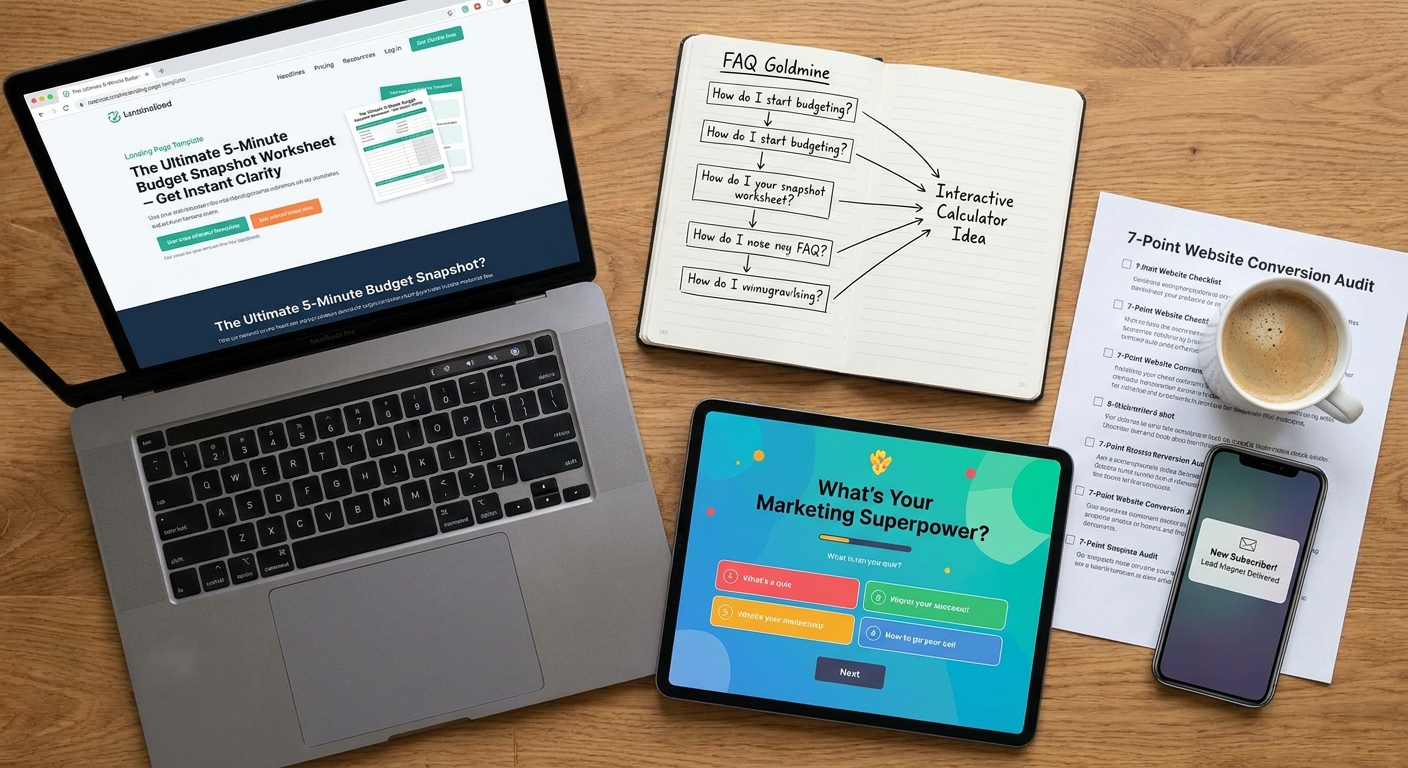
The FAQ Goldmine Method (my favorite)
Take the top three questions prospects ask you before they buy. Now turn the best one into a standalone resource.
For a financial advisor, it might be “How do I actually know if I’m saving enough?”
For a fitness coach: “Why am I not seeing results even though I’m working out?”
For a marketing consultant: “Why isn’t my website converting visitors into leads?”
These questions are pure gold because people are already asking them.
The “First Step” Framework
Another approach I love is asking: What’s the very first thing my customer needs to do to make progress?
A financial advisor might create a “5-Minute Budget Snapshot” worksheet.
A web designer could offer a “Website Health Scorecard.”
A business coach might build a “One-Page Quarterly Planning Template.”
The beauty is that these feel incredibly doable. And that feeling of immediate progress is addictive.
Formats That Actually Get Used
Let’s talk about the painfully common mistake of the 47-page ebook.
Look, I get it. You wanted to be generous. But generosity without strategy is just digital clutter. That massive ebook is probably sitting in a folder right now with 47 other “I’ll read it later” PDFs.
Instead, consider these formats that actually get consumed:
- Checklists (instant gratification + dopamine hit)
- Interactive quizzes (people love learning about themselves)
- Calculators (gives them a specific number they can act on)
- Short email courses (delivers value over 5-7 days)
- Templates & worksheets (they do the work, you provide the structure)
- Mini-audits (shows them exactly where they’re leaking opportunity)
The Good, The Bad, and The Ugly
Let’s make this concrete with a case study.
The Ugly: “Sign up for our newsletter!”
(No value proposition. Zero reason to care. The marketing equivalent of “Because I said so.”)
The Bad: The 50-page “Ultimate Guide to Digital Marketing”
(Well-intentioned but overwhelming. It becomes homework instead of help.)
The Good: The “7-Point Website Conversion Audit Checklist”
This one is magic. It’s specific. It’s immediately useful. It lets the reader diagnose their own website. And most importantly, it positions the marketing agency as the obvious expert to fix what the checklist reveals.
That last part? That’s the secret sauce. Your lead magnet should be the appetizer, not the full meal.
Delivery Matters More Than You Think
Here’s my unbreakable rule: The user experience after clicking “submit” should feel like a high-five.
That means:
- A clean, benefit-focused landing page (no distractions)
- A form that asks for only their email (every extra field is a friction point)
- Instant, automatic delivery
- A thoughtful follow-up sequence that continues the conversation
The technology for this is genuinely easy now. Tools like ConvertKit, Flodesk, Carrd, and Leadpages have made what used to require a developer something any business owner can set up in an afternoon.
Your One Action Item This Week
Don’t just listen and nod along. Let’s make this real.
I want you to do this today:
- Write down the single most common question your prospects ask before they buy.
- Brainstorm three different ways you could answer that question in a remarkably helpful format.
- Pick the one that feels most exciting to create.
That’s it.
If you get stuck, reply to this email or drop a comment below. I actually read them all.
The Bottom Line
A truly great lead magnet solves a specific, pressing problem, delivers an immediate win, and gives away genuine value without hesitation.
When you do this right, subscribing to your list stops feeling like a transaction and starts feeling like the beginning of a really good relationship.
And that, my friend, is when marketing gets fun.
I’m really excited about our next episode. We’re diving into “The Financial Case for Managed Services” — how to move marketing from a cost center to a legitimate profit center in your business. It’s going to be a good one.
Until then, go make something so valuable that people feel lucky to get it.
You’ve got this.
Talk soon,
Your slightly obsessed marketing mentor
P.S. What’s the most common question your prospects ask you? Drop it in the comments — I might just help you turn it into a lead magnet idea.