Hello and welcome back to The Busy Business Owner’s Guide to Marketing! It is so good to have you here with me again for episode 36.
Today, we’re grabbing a big, intimidating topic by the horns: Paid Ads on a Small Budget.
I know what happens for many of you the moment I say “paid ads”. Your shoulders tense up, your wallet instinctively hides, and you have visions of setting a pile of cash on fire. It can feel like you’re just throwing money into the digital abyss, hoping something sticks. But what if I told you there was a way to run ads where your customer acquisition could be, for all intents and purposes… free?
It sounds a little too good to be true, I know. But with the right strategy, you can transform your ad spend from a terrifying expense into a predictable, hard-working asset that grows your business on autopilot. This is exactly what a “Tripwire Funnel” does, and it’s one of my favorite strategies for anyone feeling nervous about paid advertising.
So, grab a coffee, settle in, and let’s talk about how to make your ad budget work for you, not against you. This one’s a game-changer.
So, What Exactly Is a Tripwire Funnel?
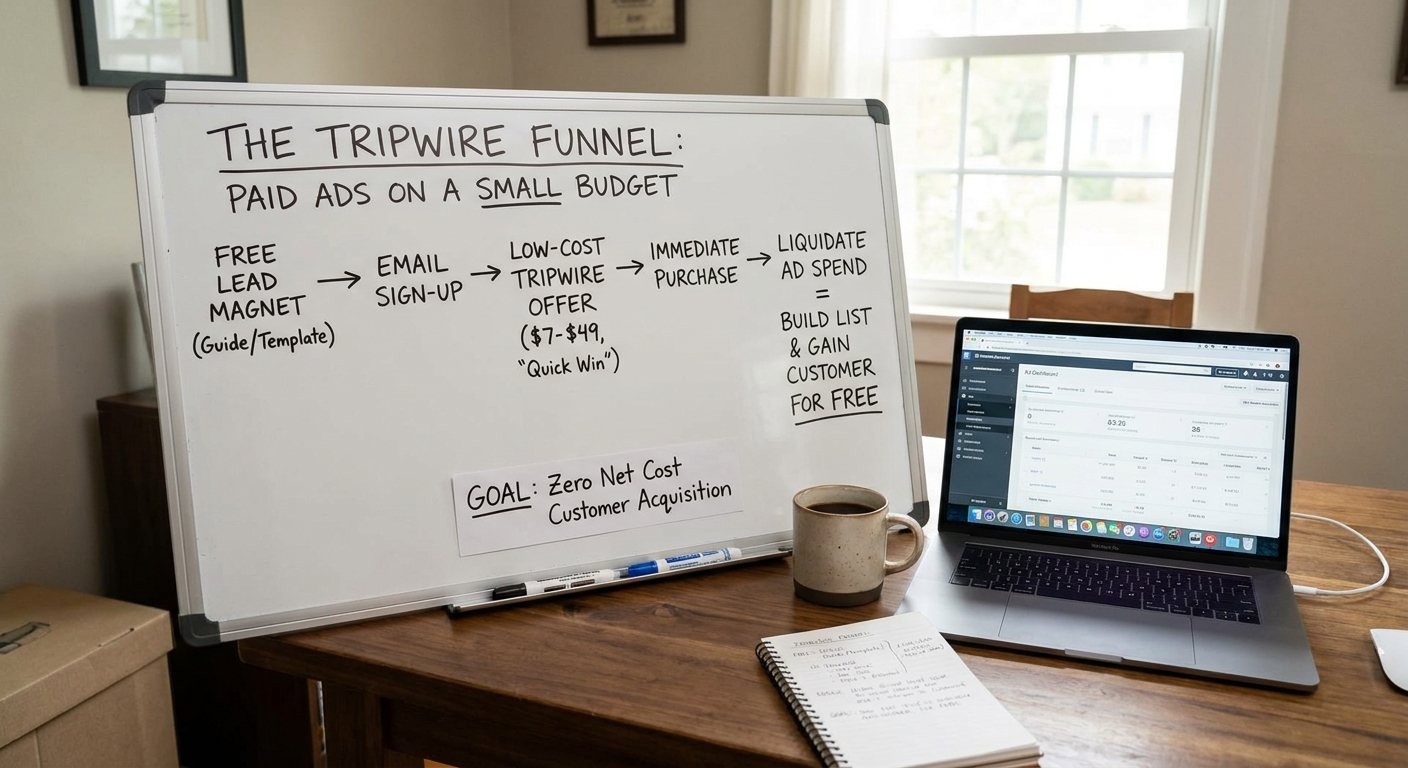
Alright, let’s demystify this thing. Forget complicated diagrams and marketing jargon for a moment. At its heart, a Tripwire Funnel is a simple, elegant two-step dance designed to do one thing beautifully: get your ad spend back immediately.
Let me paint a vivid picture of how it works:
- The First Step (The Lure): You start by attracting your ideal customer with a fantastic, high-value freebie. This is what we call a Lead Magnet. It could be a PDF guide, a checklist, a video tutorial, a template—anything that solves a small, specific problem for them. In exchange for this awesome free resource, they give you their email address. Win-win.
- The Second Step (The Tripwire): The moment they enter their email and click “download”, something magic happens. Instead of a boring, generic “Thank you, check your email!” page, they are immediately taken to a new page. On this page, you present them with a low-cost, high-value, completely irresistible one-time offer. This is the tripwire.
The entire goal here isn’t to make a massive profit from that small sale. The real magic is that the money you make from the few people who buy this tripwire offer is designed to perfectly offset the cost of the ad that brought them all to you in the first place.
Think of it as a self-fueling engine for growth. You put a dollar into the ad machine, the machine brings you a handful of new leads, and then it immediately spits your dollar right back out at you. The result? You’re left with a growing email list and new paying customers, all for a net cost of zero. It’s how you build a list of buyers without risking your shirt.
The Anatomy of a Perfect Tripwire Offer
Now, you can’t just throw any old product up there and hope for the best. The tripwire offer itself has to be engineered for success. I’ve seen people get this wrong in a hundred different ways, but the ones that work beautifully always have three things in common.
1. The “No-Brainer” Price Point
My personal rule of thumb is that a tripwire should be a true impulse buy. We’re generally talking about the $7 to $49 range. Why? Because it’s low enough that your new lead doesn’t have to call a family meeting to make a decision. It’s the price of a couple of fancy coffees or a lunch out. It feels like a small, easy “yes” for something that provides real value, making the decision process almost frictionless.
2. It Delivers a “Quick Win”
A great tripwire solves a small, specific, and often annoying problem for your customer right away. It’s not a 200-page ebook or a six-week course. It’s a tool, a template, or a guide that gives them an immediate result. This is incredibly important because it builds instant trust and showcases your expertise. They think, “Wow, if their $10 thing is this helpful, imagine what their main program can do!”
A productivity coach I know offers a fantastic free webinar on beating procrastination. Her tripwire? A $10 “Perfect Week Planning” template pack. It’s the perfect quick win—it helps her new leads get organized tonight and gives them a real taste of her full coaching system.
3. It’s a Logical Bridge to Your Core Offer
This might be the most important piece of the puzzle. My unbreakable rule is this: your tripwire must be the logical first step someone would take before buying your main product or service. It can’t be a random, unrelated item. It has to feel like the first piece of a larger puzzle you’re helping them solve.
- If you’re a photographer selling a course on portrait photography, your tripwire could be a pack of premium portrait editing presets.
- If you’re a financial advisor, your tripwire could be a sophisticated but easy-to-use budget spreadsheet.
- If you’re a web designer, your tripwire could be a “Landing Page That Converts” template.
See the pattern? The tripwire provides immediate value while perfectly setting the stage for what comes next.
My Simple Three-Step Setup Process
Okay, I can feel some of you thinking, “This sounds great, but also complicated.” I promise, it’s simpler than you think. You only need to build three simple things.
- Part 1: The Lead Magnet Landing Page. This is a simple webpage with one job and one job only: to get people excited about your free lead magnet and convince them to sign up. No distractions, no navigation menu, just a killer headline, a few bullet points about the benefits, and a big, beautiful button to opt-in.
- Part 2: The Tripwire Sales Page. This is where your new lead lands immediately after opting in. This is NOT a “thank you” page. It’s a simple sales page that says something like, “Wait! Your free guide is on its way to your inbox, but while you wait, check out this special one-time offer…”. It’s crucial to use urgency and scarcity here. Emphasize that this offer at this price is only available on this page, right now.
- Part 3: The Ad Itself. And here’s a pro tip that will save you a ton of headache: do not mention the paid tripwire offer in your ad. The ad’s entire job is to sell the value of the free thing. That’s it! You want to get the cheapest clicks and the most sign-ups possible. Let the funnel do the heavy lifting of converting leads into buyers. Each part of your system has one job—let it do it well.
Let’s Do the Math (This is the Fun Part!)
This is where the lightbulb really goes on for most people. Let’s break down some simple, conservative numbers so you can see how powerful this is.
Let’s say you decide to dip your toes in and spend $50 on a Facebook ad.
- Your ad is focused on your amazing free guide. With a decent ad, you might get a new email subscriber for around $2. We call this your Cost Per Lead (CPL).
- So, your $50 ad spend gets you 25 new leads on your email list. Not bad!
- Now, your tripwire offer is priced at an easy-to-say-yes-to $10.
- Out of those 25 new people who just signed up, you only need 5 of them to buy your tripwire offer. That’s a 20% conversion rate, which is very achievable for a compelling, low-cost offer.
- 5 people x $10 = $50 in revenue.
Let’s look at the final score:
Ad Spend: $50
Tripwire Revenue: $50
Net Cost to Acquire 25 Leads and 5 Customers: $0
Boom. You just made back your entire ad spend. You now have 25 new prospects on your email list to nurture and build a relationship with, and you have 5 brand new paying customers who have already proven they are willing to invest in your solutions. You’ve done all of this for a net cost of zero. This is how you de-risk paid advertising and build a system you can scale with confidence.
The Big Picture: Why This Works
I want to be crystal clear: the Tripwire Funnel isn’t about getting rich off a $7 product. It’s a smart engine for sustainable growth. It’s a strategy designed to completely liquidate your ad spend so you can focus on the real prize: building your most valuable business assets.
And what are those assets? A high-quality email list and, even more importantly, a list of buyers. Someone who has paid you even just one dollar is infinitely more valuable and more likely to buy again than someone who has only ever consumed your free content.
So, your mission this week, should you choose to accept it, is to brainstorm. Sit down with a piece of paper and ask yourself: What is a “quick win” I could offer my customers? What’s a small, valuable first step on the journey of working with me?
That, my friend, is your tripwire.
Thank you so much for joining me today. I hope this pulls back the curtain on paid ads and makes them feel a whole lot more accessible.
Join us next week as we tackle organization and consistency with Episode 37: Creating a Content Calendar You’ll Actually Stick To. It’s going to be a good one!
Until then, keep building. And if you have any questions or tripwire ideas you want to share, drop them in the comments below—I’d love to see what you come up with!