
Hello and welcome back! It’s so good to have you here for episode 34 of The Busy Business Owner’s Guide to Marketing. Today, we’re going to tackle a topic that I believe is one of the most powerful mindset shifts you can make for your business: The Quarterly Marketing Rhythm.
Does your marketing ever feel like a frantic game of Whac-A-Mole? An urgent email pops up, so you whack it. A social media trend explodes, so you scramble to jump on it. A competitor launches something new, and suddenly your whole week is derailed. You’re constantly reacting, putting out fires, and by the end of the month, you look back and wonder, ‘What did we actually accomplish?’
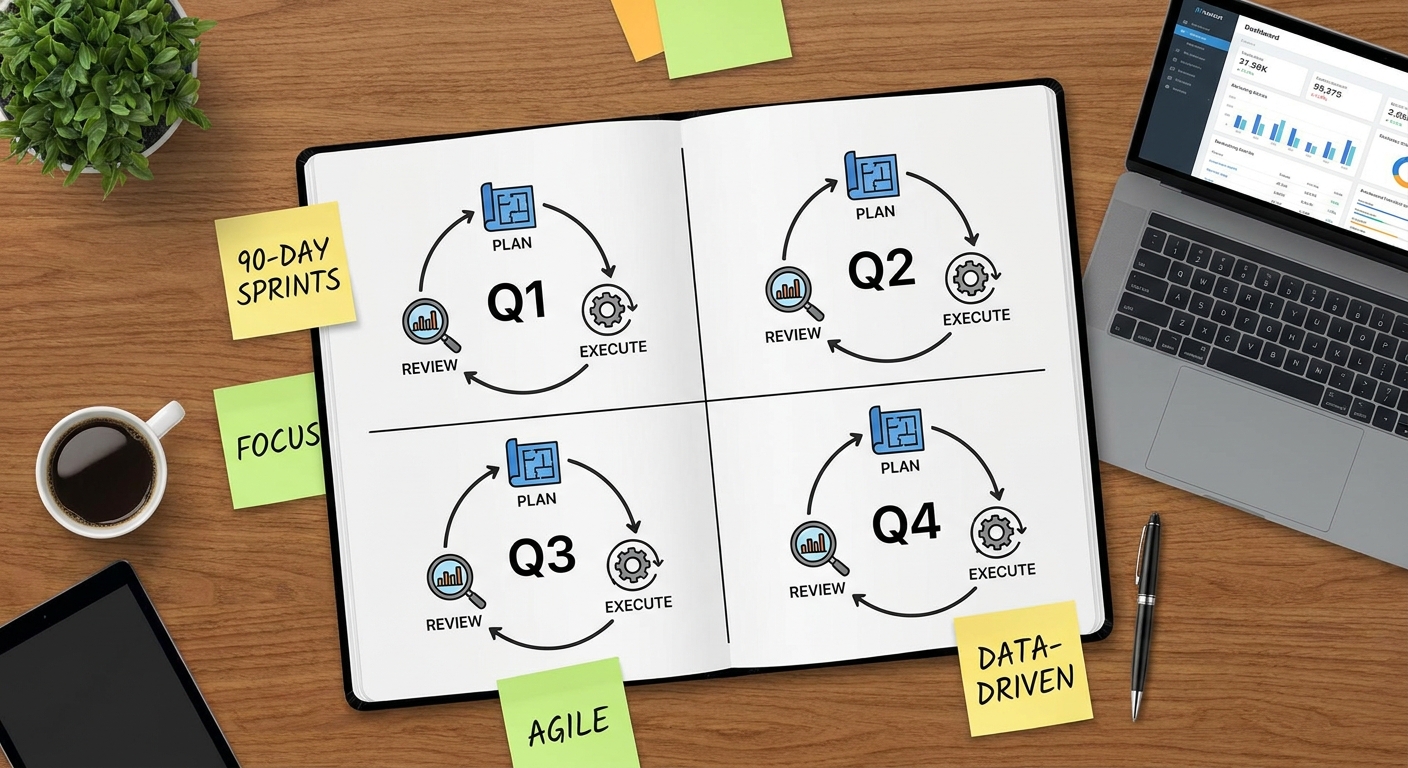
If that sounds painfully familiar, you are not alone. It’s the default state for so many overwhelmed business owners. But what if I told you there’s a way to get out of that ‘always on’ chaos? A way to trade that frantic, reactive energy for focused, intentional momentum? That’s exactly what we’re building today: a simple, repeatable framework for planning, executing, and reviewing your marketing in manageable 90-day sprints. This rhythm will give you focus, clarity, and most importantly, a profound sense of control over your own marketing destiny. Ready? Let’s dive in.
Why 90 Days is the Magic Number
So, you might be wondering, ‘Why 90 days? Why not plan for the whole year or just go month by month?’ It’s a great question, and I’ve seen teams try it all. Here’s what I’ve learned.
Big, ambitious annual plans often feel great to create in January. They’re full of hope and beautifully formatted charts. The problem? They’re often irrelevant by March. The market shifts, a new competitor emerges, a golden opportunity you couldn’t have predicted lands in your lap, and suddenly that beautiful document is just gathering dust in a shared drive. It’s too long, too rigid, and too far away to inspire real action today.
On the flip side, trying to plan month-to-month can feel like you’re on a frantic hamster wheel. You’re so caught up in hitting immediate targets that you never get to those bigger, more meaningful projects—the website redesign, the new video series, the deep-dive customer research. You’re working hard, but you’re not necessarily moving forward.
Ninety days, I find, is the absolute sweet spot. It’s long enough to make significant progress on meaningful projects, but short enough to stay relevant and agile. Psychologically, it feels like a goal you can actually hit, which creates a healthy sense of urgency that a 12-month plan just can’t.
Let me paint a vivid picture. Think of it like building a house. Staring at the complete blueprint for a five-bedroom home is overwhelming. But if the builder says, ‘For the next 90 days, we are going to focus only on framing and perfecting the kitchen,’ that feels achievable. You can pour all your energy into making that one room perfect, knowing the rest will come in the next focused sprint. That’s the power of the quarterly rhythm.
Phase 1: The Quarterly Planning Session
Everything starts here. My personal rule of thumb is to treat this session as sacred. It’s not a casual brainstorm; it’s a structured, focused, and mandatory meeting for everyone involved in marketing. Get it on the calendar weeks in advance. If you can, hold it off-site to minimize distractions. This is where you set the trajectory for the next 13 weeks.
Here’s how I run a successful planning session:
- Step 1: Start with a Data-Driven Review. You absolutely cannot skip this. Before you look forward, you must look back with brutal honesty at the quarter you just finished. What actually worked? Not what you felt worked, but what the data says. Which campaigns drove leads? Which blog posts got traffic? Where did your best customers come from? This isn’t about blame; it’s about learning.
- Step 2: Set 1-3 Primary Objectives. Notice I didn’t say ten. The magic of the 90-day sprint is focus. You need to choose just one to three primary, measurable objectives for the quarter. A client of mine, a boutique consultancy, set a fantastic one: ‘Increase qualified webinar sign-ups by 20%.’ It’s not ‘get more leads’; it’s specific, measurable, and everyone on the team understands what success looks like.
- Step 3: Define Your ‘Big Rocks’. Once you have your objective, you can identify the key campaigns or projects that will get you there. These are your ‘Big Rocks’—the major initiatives that will take up the most time and resources. For the consultancy, their Big Rocks were: 1) A 4-week LinkedIn ad campaign promoting the webinar, and 2) A 3-part email series to their existing list. Everything else was secondary.
- Step 4: Assign Clear Ownership. A plan without owners is just a wish list. Every Big Rock and its supporting tasks must have a single person who is ultimately responsible for its completion. This creates accountability and ensures nothing falls through the cracks.
Phase 2: Agile Execution & The 15-Minute Momentum Meeting
Okay, you’ve got this brilliant, focused 90-day plan. You’re feeling energized! But how do you keep that momentum going for 13 weeks without getting sucked back into the daily grind? The answer is a tiny but mighty habit I call the 15-Minute Momentum Meeting.
This is a super-short, standing-room-only (if you can!) weekly ‘Marketing Huddle’. Honestly, fifteen minutes is all you need. The goal isn’t to solve every problem right there and then. The goal is to maintain alignment and momentum. We simply go around the room and answer three questions:
- Are we on track to hit our quarterly objective?
- What’s getting in our way (what are our blockers)?
- What is the single most important priority for this week to move our Big Rocks forward?
This quick check-in is the glue that holds the quarter together. It prevents that slow, silent drift that can cause you to be completely off-course by week six. It keeps everyone focused on the main goal and helps the team solve problems quickly.
And remember, your quarterly plan is a guide, not a rigid script. This execution phase is all about being agile. If real-time data from week three shows that your LinkedIn ads aren’t performing, the Momentum Meeting is where you flag it and make an intelligent pivot. It’s all about smart, focused action, not just blindly following a map off a cliff.
Phase 3: The Unskippable Quarterly Review
And that brings us to the final, and honestly, the most crucial phase: The Quarterly Review. This is the session at the very end of the quarter where you close the loop. It’s where you harvest all the learnings that will make your next quarter even more successful. This isn’t just a quick chat; it’s a dedicated session where you look back with clear eyes before you plan forward.
I have one unbreakable rule for this meeting: this is about data, not feelings. It’s so easy to say, ‘Oh, I felt like that campaign went really well!’ We’re not interested in feelings here. We’re interested in reality. You’ll want to pull the actual reports and measure performance directly against those specific objectives you set 90 days ago. Did the consultancy increase webinar sign-ups by 20%? Yes or no? If yes, how? If no, why not?
The key output from this meeting, and my absolute favorite tool for continuous improvement, is a simple ‘Start, Stop, Continue’ list.
- Start: Based on our data and new opportunities, what new things should we start doing next quarter?
- Stop: Based on the data, what was ineffective, wasted resources, or simply didn’t work? What should we stop doing immediately?
- Continue: What worked brilliantly? Which activities had a clear, positive ROI that we should continue or even double down on?
This isn’t just a nice-to-have exercise. This ‘Start, Stop, Continue’ list becomes the essential, non-negotiable input for your very next quarterly planning session. It’s a beautiful, self-correcting loop that ensures your marketing gets smarter, sharper, and more effective every 90 days.
From Passenger to Pilot
When you put it all together, the rhythm is beautifully simple: Plan, Execute, Review. You plan your quarter with intense focus on a few key objectives. You execute with agility, using a weekly huddle to stay on course. And you review with honest, hard data to inform your next move. That’s it.
What I have seen time and time again is that this system moves you from being a passenger in your own marketing—getting jerked around by every new demand and distraction—to being the pilot, intentionally steering the ship toward a destination you chose. It’s the ultimate antidote to marketing chaos.
So now that you have this framework for your internal efforts, how do you make sure any agencies, freelancers, or partners you work with are aligned and delivering real value? Well, that’s a perfect cliffhanger!
Next time, we’re diving into a big one: ‘What Your Done-For-You Partner Should Be Reporting On (And What’s Just Fluff)’.
Thank you so much for reading. I hope this gives you a tangible way to take back control of your marketing. Give this rhythm a try for one quarter, and let me know how it transforms your work. I’d love to hear about it in the comments below!
Until next time, keep marketing smart.