
Hello and welcome back!
Hello, amazing people, and welcome back to Episode 43 of The Busy Business Owner’s Guide to Marketing! I am so glad you’re here today because we’re going to do something that is, in my opinion, one of the most powerful things you can do for your business: we’re going to look ahead. We’re going to lift our gaze from the immediate to-do list and scan the horizon together.
It’s so incredibly easy to get trapped in the whirlwind of the day-to-day, isn’t it? Putting out fires, answering emails, just reacting to whatever the day throws at you. It’s like driving in heavy traffic, your eyes glued to the bumper of the car right in front of you. But the best drivers, the ones who get to their destination smoothly and safely, are always scanning the road far ahead. They see the slowdowns before they happen. That’s exactly what we’re doing today.
The next 18 months represent a critical window of change. We’re seeing major shifts in technology, privacy, and customer expectations. Getting ahead of these changes now means you’re building a proactive, resilient marketing strategy that can weather any storm. You’ll be the one calmly navigating the turn while everyone else is slamming on the brakes.
So, grab your coffee, get comfortable, and let’s dive into the four key trends that will define the next year and a half.
Trend #1: The Gold Rush for Zero-Party Data
Alright, let’s start with a big one. You’ve probably heard about the impending “death” of the third-party cookie—those little digital trackers that follow us around the web, gathering data on our browsing habits. For years, marketers have relied on them. Now, with privacy concerns front and center, they’re being phased out.
Some people see this as a crisis. I see it as a massive opportunity.
This shift is forcing us to move toward something far more valuable and ethical: Zero-Party Data. It sounds technical, but the concept is beautifully simple. It’s data that your customer intentionally and proactively shares with you. Think of it as the difference between eavesdropping on a conversation and being invited into it. One is creepy; the other builds a real relationship.
So how do you get it? You make it fun and valuable for them to share!
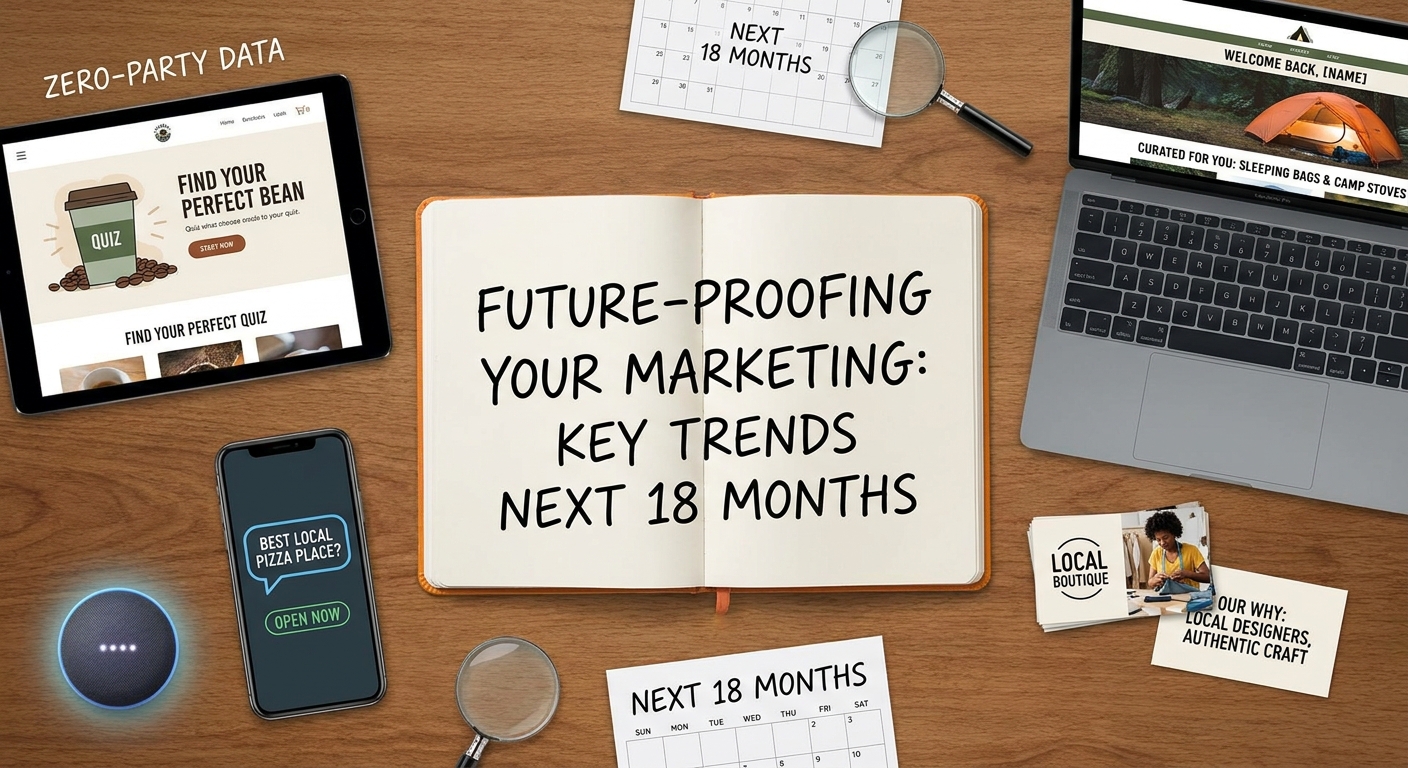
Let me paint a vivid picture. I recently saw a local coffee roaster do this brilliantly. They created a simple, two-minute quiz on their website called “Find Your Perfect Bean.” It asked fun questions like, “How do you take your coffee?” and “What’s your ideal Sunday morning?” At the end, you got a personalized recommendation, along with a 10% discount on your perfect match. Genius! They learned about their customers’ preferences directly from the source and made a sale in the process.
You can do this in so many ways:
- Quizzes and Polls: Help customers find the right product or service for them.
- Preference Centers: Let email subscribers choose what kind of content they want to receive and how often.
- Post-Purchase Surveys: A simple, “How can we make your next experience even better?” shows you care and gives you priceless feedback.
The key is the value exchange. You’re not just taking data; you’re giving them a better, more personalized experience in return. This builds a foundation of trust that is simply unshakable.
Trend #2: AI-Powered Hyper-Personalization (That’s Actually Helpful)
Now that you’re building this amazing, trust-based collection of Zero-Party Data, what do you do with it? You use it to make every customer feel like they are your only customer. This brings us to our second trend: AI-powered hyper-personalization.
For years, “personalization” meant popping a [First Name] tag into an email subject line. Let’s be honest, that’s the bare minimum. We can do so much better, and thankfully, the tools to do it are more accessible than ever.
Today’s AI can help you create genuinely one-of-a-kind experiences. Imagine this: a customer buys a new tent from your online outdoor gear store. The AI logs this purchase. The very next time they visit your website, the homepage doesn’t show them a generic welcome message. Instead, it dynamically changes to feature a curated selection of compatible sleeping bags, camp stoves, and a blog post titled “The Top 5 Campsites Within a 2-Hour Drive.”
That’s not just marketing; that’s a service. It says, “We see you, we get you, and we want to help you on your next adventure.” It’s a powerful way to build loyalty without being intrusive.
My personal rule of thumb here is what I call the “Helpful or Creepy?” test. Before implementing any personalization, ask yourself: does this make my customer’s life genuinely easier or more delightful? If the answer is a resounding yes, you’re on the right track. If it just feels like you’re a private investigator watching their every move, it’s time to pull back.
Trend #3: Getting Found in a Conversational World
Think about how you search for things now. You might not even type anymore. You might just ask your phone, “What’s the best local pizza place that’s open right now?” or tell your smart speaker, “Find me a highly-rated plumber near me.”
This is Conversational Commerce, and it’s our third major trend. People are talking to their devices more than ever, and your business needs to be ready to answer.
So, what I often tell my clients is to start by thinking about how real customers ask questions out loud. Is your online business information—your address, hours, services, phone number—crystal clear, consistent, and up-to-date across Google, Yelp, and your own website? If someone asks their phone for a business like yours, you want to be the answer that comes back. That’s the foundation.
Beyond search, you can invite conversation directly on your own turf. Adding a simple chatbot to your website can be a total game-changer. And I’m not talking about some multi-million dollar, super-complex AI that can debate philosophy. I mean a basic, friendly bot that can act as your 24/7 digital receptionist. It can answer common questions (“Do you offer gift wrapping?”), check opening hours, or capture an email address when you’re closed. It’s a low-cost, high-impact way to be helpful around the clock, ensuring you never miss a potential customer.
Trend #4: Marketing That’s Authentic and Value-Driven
This final trend is my favorite because it feels like the heart and soul of everything we’ve just discussed. Customers today, especially younger generations, don’t just buy a product; they buy into a brand. They want to support businesses that share their values and have a story they can believe in.
This is Value-Driven Marketing, and it’s about being authentically you.
This isn’t about grand, expensive gestures. It’s about pulling back the curtain and showing people the ‘why’ behind what you do. I worked with a small clothing boutique that was struggling to compete with fast-fashion giants. We decided to stop talking about sales and start sharing stories. They began posting short videos about the local designers they sourced from, showing the faces and the incredible craft behind the clothes. They wrote about their commitment to sustainable fabrics.
The result? They didn’t just sell more clothes; they built a community. Customers started coming in and asking for designers by name. They felt connected to the mission and became fierce advocates for the brand.
My unbreakable rule here is this: Don’t just tell people what you do, show them who you are. You can do this by:
- Sharing your origin story.
- Highlighting a team member and their passion.
- Explaining why you chose a particular supplier or material.
- Showing your team’s volunteer day.
Authenticity is a magnet. It transforms customers who make a transaction into a true community that wants to see you succeed.
Tying It All Together
So, let’s take a breath and zoom back out. We’ve covered a lot of ground today, from the tactical shift to Zero-Party Data to the deeply human connection of Value-Driven Marketing. We talked about using AI for a hyper-personal touch and being ready for the rise of Conversational Commerce.
But if you boil it all down, there’s one golden thread that runs through every single one of these trends: building direct, authentic relationships based on trust.
When you stop thinking about these as four separate marketing tasks and start seeing them as four ways to strengthen your relationship with your customer, everything clicks into place. You’re not just chasing a trend; you’re building a resilient, future-proof business that people love.
I hope this helps you feel excited and prepared for the road ahead!
Join us next time for episode 44, ‘Taming the Inbox: Strategies for Managing Email Overload So You Can Focus on Growth’—it’s going to be a lifesaver, I promise.
Until then, I’d love to hear your thoughts! Which of these trends are you most excited to tackle? Drop a comment below. Keep building, keep connecting, and I’ll see you next time.