
Hello and welcome back, my friend!
I know what you’re thinking. The moment I said “competitor analysis,” you felt that familiar wave of dread. It sounds like something that requires three days, twelve tabs, and a spreadsheet that will inevitably get filed away in the digital equivalent of a dusty drawer.
Today I’m changing that for you.
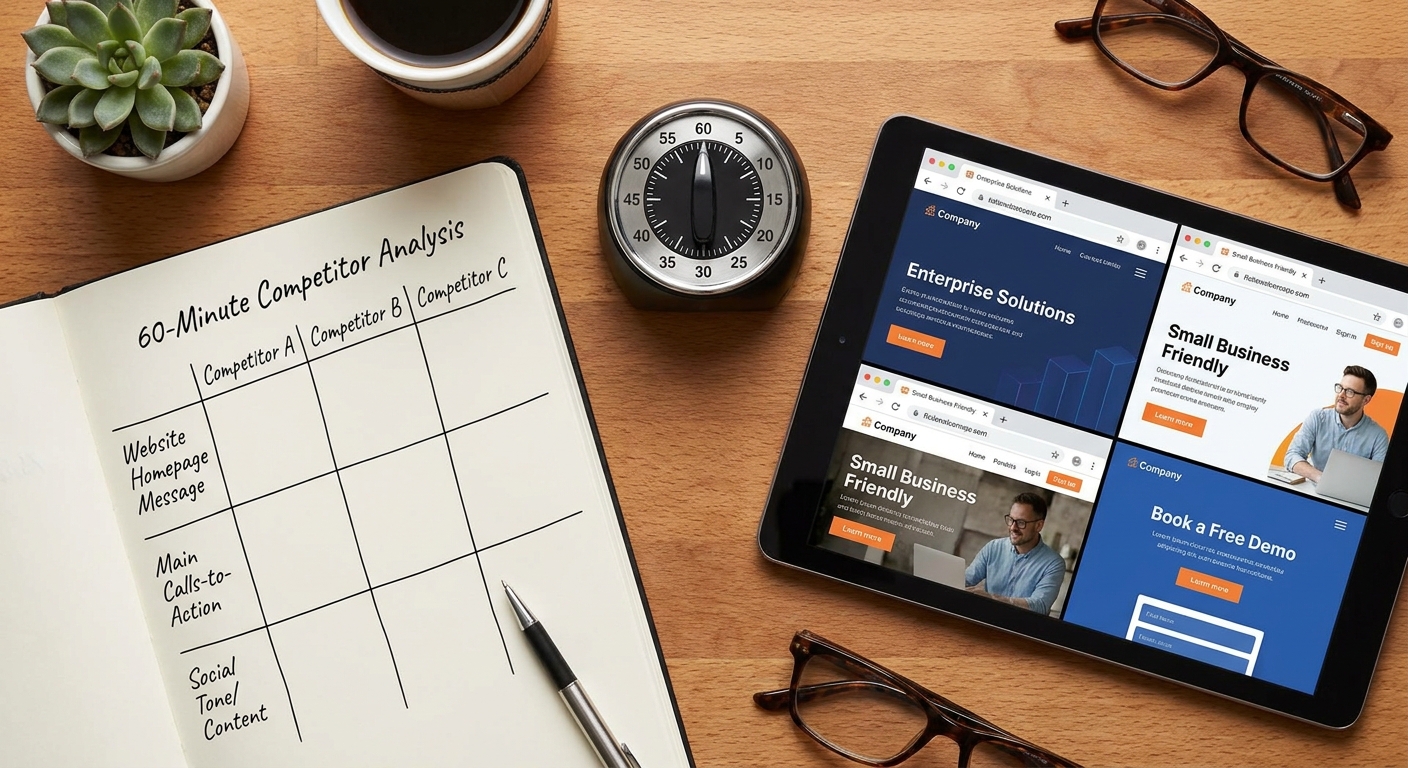
In this episode of The Busy Business Owner’s Guide to Marketing, I’m giving you a focused, high-impact framework that delivers genuine, usable insights in just one hour. No fluff. No overwhelming data dumps. Just clear, actionable intelligence you can put to work before your next coffee gets cold.
Let’s dive in.
Why Most Competitor Analysis Fails (And How We’re Doing It Differently)
The biggest mistake I see business owners make is treating competitor research like a research paper. They try to analyze eight competitors, track forty metrics, and end up with something that looks impressive but provides zero strategic value.
My unbreakable rule: Depth beats breadth every single time.
We’re not building a war room. We’re doing targeted reconnaissance. Think of it like being a scout rather than a historian. We want to move quickly, notice what matters, and return with treasure we can actually use.
Ready to set your timer?
Phase 1: The 5-Minute Setup (Don’t Skip This!)
The first five minutes are sacred. Get this right and the entire hour becomes ten times more effective.
Here’s exactly what I do:
1. Pick only 2-3 direct competitors.
Resist the urge to cast a wider net. I’d rather you deeply understand two true rivals than superficially glance at seven. These should be the businesses that make you think, “If only they weren’t there, that customer would probably choose us.”
2. Define your mission.
Before you open a single website, write down why you’re doing this analysis. Are you looking for content gaps? Trying to understand their pricing psychology? Want to sharpen your own messaging? Having a clear objective keeps your brain from wandering down interesting-but-irrelevant rabbit holes.
3. Create a simple document.
I use a basic page with columns for each competitor and rows for things like:
– Homepage headline and promise
– Primary CTAs
– Pricing structure
– Social tone
– Content themes
– Customer complaints
That’s it. No fancy templates. Just a clean workspace.
Phase 2: The 20-Minute Website Deep Dive
Timer starts. We’re going in.
When I land on a competitor’s homepage, I give myself exactly five seconds to answer: What problem do they solve, and for whom?
It’s usually right there in the main headline. The clarity (or lack thereof) tells you everything.
I once worked with a SaaS company whose biggest competitor led with “Enterprise-grade solutions for sophisticated organizations.” That single line revealed a massive opportunity. My client repositioned themselves as “The simple, powerful tool that busy small teams actually love.” The differentiation was immediate and powerful.
Next, examine their Calls-to-Action. Are they pushing a free trial, a demo, a consultation, or a lead magnet? This tells you their sales philosophy and where they’re trying to take their audience.
Finally, visit their pricing page. Don’t get lost in the weeds of every feature. Just notice the story their pricing tells. What do they want customers to value most? What do they lead with? What do they hide?
You’ll be amazed at how much personality comes through in these three areas.
Phase 3: The 20-Minute Content & Social Scan
Now we’re getting to the good stuff.
Jump over to their most active social platform and just… scroll. Like a normal person would.
What’s the tone? Corporate and buttoned-up? Or warm and conversational? Are they trying to sound like consultants or like helpful friends?
Look for the posts getting real engagement. Is it behind-the-scenes content? Customer stories? Educational videos? Quick tips? The algorithm doesn’t lie—those popular posts reveal what their audience actually cares about.
One of my favorite client stories involved discovering that their biggest competitor’s most engaged content was simple “Ask Me Anything” sessions. My client started doing the same and immediately saw their engagement (and lead quality) skyrocket.
After social media, take a quick pass through their blog. Just scan the headlines for the last 10-15 posts. You’ll get a crystal-clear picture of their content strategy and the topics they believe their audience wants.
Phase 4: The Magic 15 Minutes – Synthesis
This is where most people quit too early. Don’t.
Take the final fifteen minutes to visit a review site—Google Reviews, Trustpilot, G2, whatever applies to your industry. Don’t read every review. Look for patterns.
What are customers constantly praising?
What are they always complaining about?
I had a client discover that nearly every negative review of their main competitor mentioned a clunky, outdated interface. That single insight became the cornerstone of their entire marketing message: “Finally—a tool that doesn’t make you want to throw your computer out the window.”
Now combine everything you’ve learned.
Your mission: Walk away with two or three concrete takeaways.
Maybe it’s a content gap you can fill. A weakness you can highlight (gracefully). A messaging opportunity that makes your difference obvious. Or a new offer idea that perfectly counters their approach.
The Most Important Rule
The goal of competitor analysis is never to copy what they’re doing.
We’re looking for gaps. We’re hunting for opportunities to be distinctly, uniquely better for a specific group of people who aren’t being served the way they deserve.
Your job isn’t to become them. It’s to become the obvious choice because of what they’re missing.
Your Next Move
You now have a repeatable system you can run once per quarter. Sixty minutes. Two or three competitors. Clear insights. Real momentum.
That’s how busy business owners stay sharp without getting buried in analysis paralysis.
Next week in Episode 22, we’re diving into one of my all-time favorite frameworks: The “They Ask, You Answer” content strategy. It’s the simplest, most effective way I’ve found to create content that builds massive trust and cuts through all the noise. You won’t want to miss it.
In the meantime, I’d love to hear from you. Have you done a competitor analysis recently? What’s the most surprising insight you’ve ever discovered? Drop your thoughts in the comments.
Until next time, keep it focused, keep it useful, and keep moving forward.
Talk soon,
Your Marketing Mentor