Hello and welcome back, friend!
If you’ve ever poured months into building a lively online community only to watch an in-person event fall flat, today’s episode is going to feel like a warm hug and a swift kick in the pants at the same time.
Because here’s the truth I’ve learned after years of doing this: the strongest communities don’t live entirely behind a screen or entirely in the real world. They live in the intelligent bridge between the two.
Today we’re talking about how to use your digital community as rocket fuel for powerful, high-trust, in-person events that create unshakable loyalty. Let’s get into it.
The Painfully Common Trap
You’ve seen it (or maybe you’ve done it). The online group is humming. Comments are flowing. Emojis are flying. Then someone bravely suggests, “We should do a meetup!”
Crickets.
Or worse — ten people show up, the energy feels forced, and everyone goes home thinking, “Well, that was… fine.”
The problem isn’t that people don’t want to meet. The problem is that we treat the online and offline worlds like they’re competing instead of collaborating.
I made this mistake myself.
For an entire year I ran a mastermind that was 100% digital. The content was solid. The engagement was decent. But after our first live event, the difference was night and day. Deals were being done in hallways. Inside jokes were born over coffee. Trust levels went through the roof.
A shared memory beats a thousand Slack messages. Every single time.
That’s when I stopped seeing online and offline as an either/or choice and started treating them as a system.
Your Digital Community Is the Launchpad, Not the Destination
Think of your online community like the mission control center for NASA. It’s where you plan, train, build excitement, and coordinate. The actual rocket launch? That’s the in-person event. One doesn’t work nearly as well without the other.
Here’s exactly how I run that system now.
Phase 1: Pre-Event Mobilization (The Anticipation Engine)
Whatever you do, don’t you dare just drop an announcement and call it a day. That’s amateur hour.
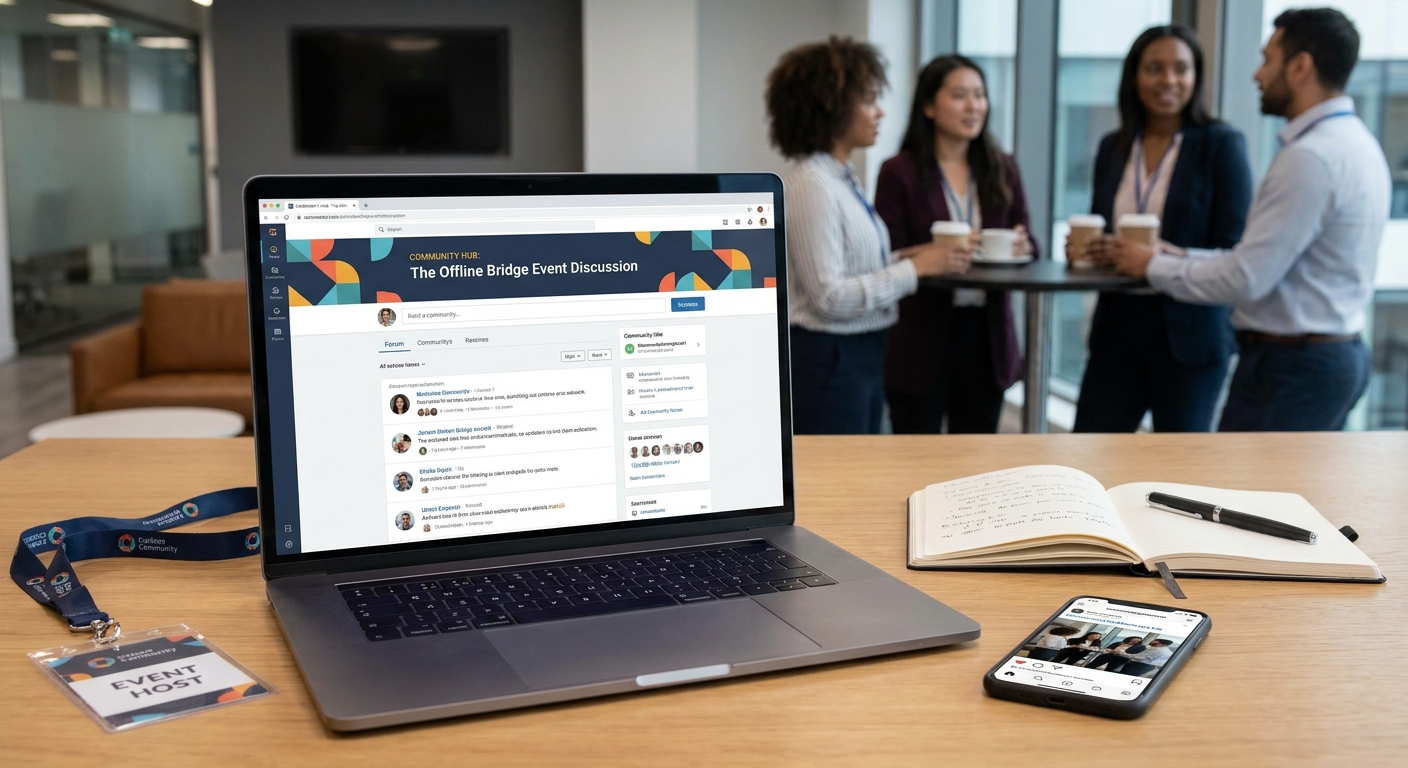
The moment a date is locked in, I create a dedicated event channel. This becomes our war room and hype machine combined.
Inside that channel I do three things that consistently work:
- Polls for co-creation: “Advanced negotiation or scaling team culture — which session do you want more?” People vote. They feel ownership.
- Behind-the-scenes content: Short videos walking through the venue, sneak peeks at the workbook, even a silly video of me testing the AV equipment. It makes everything feel real and personal.
- The Introduction Thread: About three weeks out, I post: “Drop your LinkedIn profile + one powerful question you want to ask someone else in this community.”
The networking begins before anyone leaves their house. By the time people arrive, they’re already excited to meet “Sarah who wants to talk about hiring her first salesperson” instead of staring at name tags in awkward silence.
Phase 2: Game Day — Make the Digital Space the Second Screen
This is where most people drop the ball completely.
The event starts and suddenly the online community goes quiet. Big mistake.
I turn the community into the live pulse of the event. Here’s my process:
We run a dedicated photo and moment-sharing thread (no gatekeeping). Attendees post selfies with new friends. Speakers drop behind-the-scenes shots. Someone shares a powerful quote they just heard.
We also hammer a specific event hashtag and encourage real-time posting.
For people who couldn’t attend, I’ll live-stream the keynote or a key panel. This isn’t just about FOMO — it’s about inclusion. The digital members feel like they’re still part of the room.
The community becomes a real-time shared experience that connects both the people in the physical space and those watching from afar. It’s honestly magical to watch.
Phase 3: Post-Event Amplification (Lock In the Magic)
The event ends and most organizers breathe a sigh of relief, post a few photos, and move on.
Not us.
Within 48 hours, I have a beautifully curated photo gallery in the community. No excuses. Then I create a specific thread with this prompt:
“Share your single biggest insight from the event and name one new person you’re glad you met.”
This thread is pure gold. It generates testimonials, surfaces powerful stories, and publicly celebrates the new relationships formed. I often screenshot the best parts and turn them into content later.
One week later, I release the full session recordings — but only for community members. This does two things: it delivers massive value to those who attended (they get to revisit the content) and creates powerful, authentic FOMO for everyone else.
You’re not just hosting an event. You’re building irresistible momentum for the next one.
The Simple 3-Part System I Swear By
- Pre-event mobilization — turn anticipation into co-creation
- During-event integration — make your digital space the live heartbeat
- Post-event amplification — transform the memory into lasting connection and momentum
Do this consistently and your community stops being “a nice online group” and becomes the place where real friendships, opportunities, and transformations happen.
Your Next Move
Stop thinking of your online community as the final destination. It’s the launchpad.
The handshakes, the laughter, the “I can’t believe we’re finally meeting in person!” moments — those are what create the unshakable loyalty that no algorithm can touch.
You don’t need to choose between digital and in-person. You need to master the bridge between them.
That’s it for Episode 18!
Next time in Episode 19: The AI Community Manager, we’re going to cut through all the hype and talk about how to actually use tools like ChatGPT to become more effective instead of just more busy. I’m pretty excited about that one.
In the meantime, I’d love to hear from you. Have you ever attended or hosted an event that felt magically connected to the online community? What worked? What didn’t?
Drop your thoughts in the comments. I read every single one.
Until next time — go build something worth belonging to.
Talk soon,
Your Community-Building Mentor