
Hello and welcome back to The Busy Business Owner’s Guide to Marketing!
If you’ve ever found yourself staring at a blinking cursor, completely paralyzed about what content to create next, I want you to know something: you are in extremely good company. I’ve watched dozens of sharp, capable business owners waste weeks (sometimes months) trying to guess what their audience wants.
Today I’m going to hand you a framework that makes the guessing game obsolete. It’s called They Ask, You Answer, and it might be the most practical, trust-building content strategy ever created.
Let me paint a vivid picture of how this works.
The Revolutionary Simplicity of They Ask, You Answer
The entire philosophy, created by Marcus Sheridan, boils down to one disarmingly simple idea:
Stop trying to be clever. Start answering the exact questions your customers are already asking.
That’s it.
You stop selling and start teaching. You transform your website from a digital brochure into the most helpful, transparent resource in your industry. And in doing so, you become the trusted advisor people seek out before they ever pick up the phone.
I’ve seen this approach completely transform businesses. One company I worked with was in a highly competitive, somewhat skeptical industry. Once they started addressing customer fears head-on instead of dancing around them, something magical happened. Prospects began showing up to sales calls already trusting them. The questions had already been answered. The relationship was halfway built before a single conversation took place.
That’s the power we’re talking about.
The Mindset Shift That Changes Everything
At its core, They Ask, You Answer requires a fundamental identity shift. You move from being “the seller” to becoming “the teacher.”
Think of it like this: Imagine having the world’s most knowledgeable, transparent, and patient salesperson available 24/7 on your website. They never get tired. They never avoid tough questions. They just help people make informed decisions.
That’s what your content becomes.
The goal isn’t to sound impressive. The goal is to be useful. Obsessively, almost ridiculously useful.
My unbreakable rule of thumb here: If it feels slightly uncomfortable to publish, you’re probably on the right track. The content your competitors are too scared to create is usually the content that builds the most trust.
The Big 5: Topics Your Competitors Won’t Touch
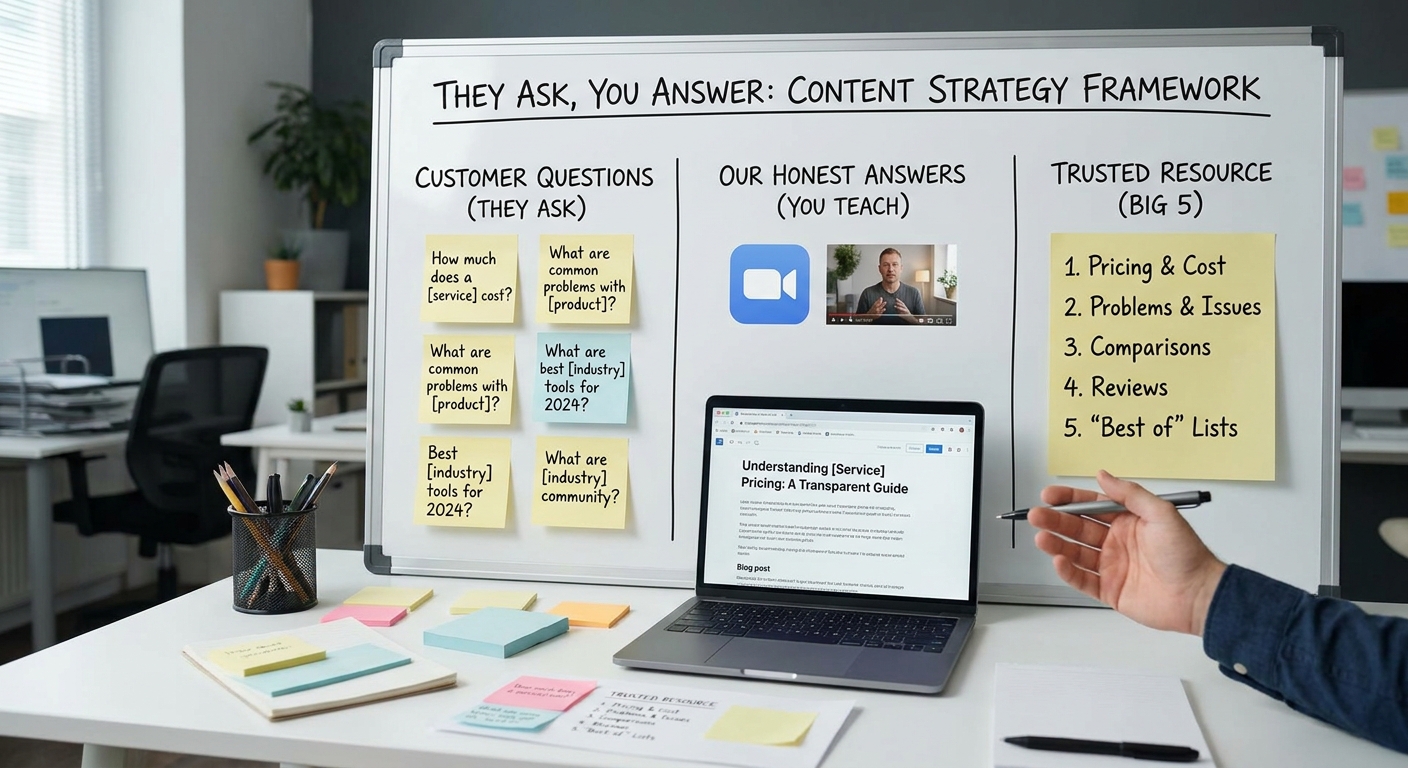
Marcus Sheridan discovered that nearly every major purchase involves research around five key areas. I call them the Big 5, and they should form the foundation of your content strategy:
- Pricing and Cost – Be upfront about money. Yes, really.
- Problems and Drawbacks – Honestly discuss the negatives and limitations.
- Comparisons – How you stack up against competitors (yes, name names).
- Reviews – Share both the good and the not-so-good feedback.
- “Best Of” Lists – Help people understand which option is genuinely best for their situation.
These topics are pure marketing gold because your competitors are usually terrified of them. While they’re publishing fluffy “Top 10 Tips” articles, you’re answering the questions that actually keep your prospects up at night.
The business that wins is usually the one willing to have the uncomfortable conversations first.
Where to Find Your Million-Dollar Questions
Here’s the beautiful part—you’re probably sitting on a goldmine of content ideas right now.
My favorite process for collecting questions:
First, talk to your sales team (or yourself if you’re the one taking calls). Ask them: “What are the top five questions you get asked every single day?” Their answers will be pure content inspiration.
Next, do a brain dump. Set a timer for 20 minutes and write down every question you’ve ever been asked by customers or prospects. Don’t overthink it. Just get them on paper.
Finally, use Google’s “People Also Ask” feature as a cheat code. Type in one of your common questions and watch the related questions appear like magic. I’ve discovered some of my best-performing content this way.
The goal is to create one master list. This becomes your content calendar for the next 6–12 months. No more Monday morning panic about what to write.
The “One Question, One Piece of Content” Rule
This is where most people overcomplicate things.
My simple rule: One question. One piece of content.
That’s it.
You don’t need a film crew or a graphic designer. Some of the most effective content I’ve seen was:
- A landscaper filming a 7-minute smartphone video titled “How Much Does a New Patio Really Cost in 2025?”
- A financial advisor writing a transparent breakdown of their fee structure
- A SaaS company creating a detailed comparison chart against their top three competitors
The titles should be almost comically direct. If someone is typing that exact question into Google, make your content the obvious answer.
Here’s my personal opinion: Consistency beats production value every single time. I’d rather see you publish twenty helpful but imperfect pieces of content than one gorgeous piece that took six weeks to create.
Your Challenge This Week
If you only remember one thing from this episode, let it be this: Stop selling and start answering.
That single mindset shift is responsible for more business breakthroughs than almost any other marketing tactic I’ve seen.
Here’s your challenge for this week (and I really hope you’ll do it):
Grab your sales team (or just yourself) and collect five real customer questions. That’s it. Just five. Write them down. Pick one and create a piece of content that answers it completely and honestly.
I’d love to hear what questions you come up with! Drop them in the comments below.
Thank you for spending time with me today. I genuinely appreciate it.
Be sure to join me for Episode 23, where we’re diving into “Lead Magnets That Don’t Suck” – how to create offers so valuable people actually want to give you their email address.
Until then, keep teaching, keep answering, and keep building that trust.
Talk soon,
Your friendly marketing mentor
What’s one question your customers ask you all the time? Tell me in the comments—I might just turn it into a future episode!