
Hello and welcome back, my friend!
You’ve made it to episode twenty of The Busy Business Owner’s Guide to Marketing, and today we’re tackling something that’s probably causing you low-grade daily stress even if you don’t realize it yet.
Picture this: A fresh lead fills out your website form. You copy their name and email into a spreadsheet. Then you manually add them to your email platform. Two days later you realize they’re not in your CRM. Sound familiar?
That, my friend, is the sound of opportunity quietly leaking out of your business.
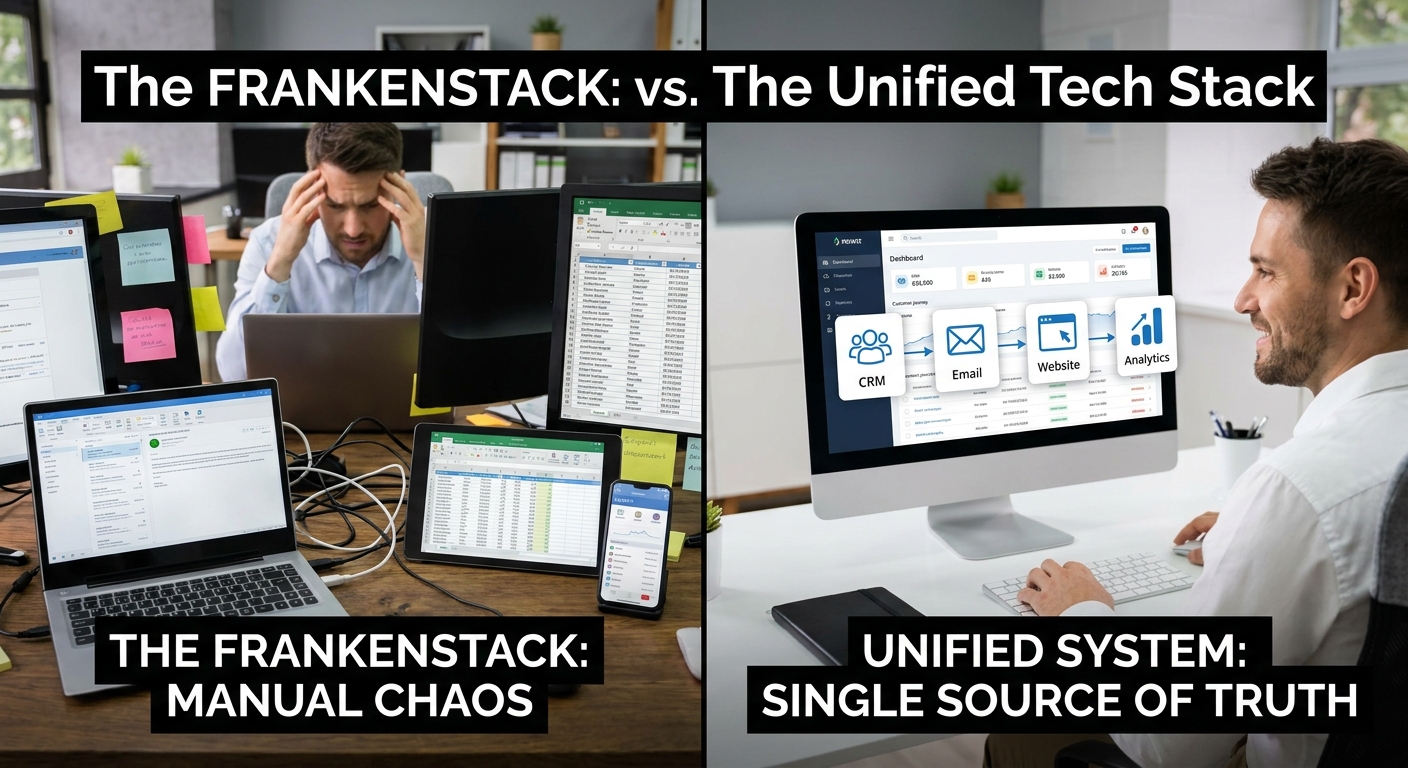
Today we’re talking about The Power of a Unified Tech Stack—or as I like to call the opposite problem, the Frankenstack.
The Monster in Your Tech Stack
The Frankenstack is that awkward collection of apps and software you’ve bolted together over time. They don’t talk to each other. They don’t share information. And they definitely don’t play nicely.
The symptoms are painfully common:
- You waste precious time copying and pasting data between systems
- The same customer has three slightly different email addresses across your tools
- Your sales team doesn’t know what marketing has already sent a prospect
- You have zero visibility into the actual customer journey
I’ve seen it dozens of times. A warm lead falls through the cracks because they were added to the email list but never made it into the CRM. A customer gets the same welcome sequence twice because the systems aren’t connected. These aren’t just annoyances—they’re lost revenue wearing a disguise.
The Single Source of Truth
The antidote is simpler than you might think.
Instead of having five different systems arguing with each other, you create what I call a single source of truth. For most of my clients, that’s their CRM. Everything else—website forms, email marketing, customer service tools, even their billing software—feeds information into the CRM rather than living in separate silos.
I worked with a small e-commerce brand last year that transformed their business with this approach. Before the change, their sales and marketing teams might as well have been working in different countries. After connecting everything, the sales rep could see exactly which emails a customer had opened, what they’d clicked, and their purchase history. The marketing team knew when someone had contacted support.
Suddenly everyone was speaking the same language. The customer experience became dramatically smoother because the right hand finally knew what the left hand was doing.
Where the Real Magic Happens
Once you have that single source of truth, something beautiful occurs: intelligent automation.
And I’m not talking about scheduling social media posts. I’m talking about systems that make your customers feel truly seen.
Imagine a customer buys from your online store. Because your systems are connected, it automatically:
– Tags them in your CRM with what they purchased
– Triggers a personalized onboarding sequence
– Sends them a “how-to” guide exactly seven days later
– Notifies your customer success person if they haven’t logged in after 14 days
Or a website visitor returns to your site. Your tools recognize them and show them content related to their previous purchase instead of generic messaging. It stops feeling like marketing and starts feeling like a helpful conversation.
This is the difference between being a broadcaster and being a trusted advisor.
Three Practical Ways to Make Your Tools Talk
I know what you might be thinking: This sounds expensive and complicated.
It doesn’t have to be. Here are the three approaches I recommend, from simplest to more customized:
1. The All-In-One Platform
Some platforms genuinely do it all. If you’re early stage or your needs aren’t overly complex, this can be the smartest move. One login, everything works together, minimal headaches. The trade-off is that these platforms rarely do everything perfectly.
2. Native Integrations
My personal favorite when possible. Choose tools that are already built to work with your core software. When HubSpot talks directly to your website platform, or your email tool has a native connection to your CRM, life gets dramatically easier.
3. The Digital Glue (My Secret Weapon)
This is where it gets fun. Tools like Zapier or Make act as the friendly matchmaker between apps that weren’t originally designed to talk. I call them “digital glue” because they connect the pieces that would otherwise remain separate. Some of the most elegant systems I’ve seen use this approach.
My unbreakable rule: If you’re copying and pasting the same information more than twice, your tech stack is broken and needs fixing.
Stop Seeing This as a Tech Problem
Here’s the shift I want you to make today.
Stop thinking about connecting your tools as a technology project. Start seeing it as a strategic business advantage. When your systems talk to each other, you don’t just save time—you create better customer experiences, close more sales, and build a business that doesn’t depend on you manually moving data around like a digital hamster on a wheel.
The businesses winning right now aren’t necessarily the ones with the biggest marketing budgets. They’re often the ones whose technology works as a coordinated team instead of a dysfunctional group project.
Your Turn
So tell me in the comments: What’s the biggest “Frankenstack” moment happening in your business right now? Are you manually moving data between systems that should be talking? Which two tools in your stack are causing you the most pain?
I read every comment, and I love geeking out about this stuff with you.
Thank you for spending this time with me today. I genuinely hope this episode helps you see your tech stack not as a necessary evil, but as one of your most powerful (and fixable) business assets.
I’ll see you in Episode 21, where we’ll dive into “How to Conduct a 60-Minute Competitor Analysis That’s Actually Useful.” I’m sharing a lean framework that consistently gives my clients genuine strategic edges.
Until then, stop juggling data and start connecting systems.
Talk soon,
Your marketing mentor who’s tired of seeing good leads fall through technological cracks